
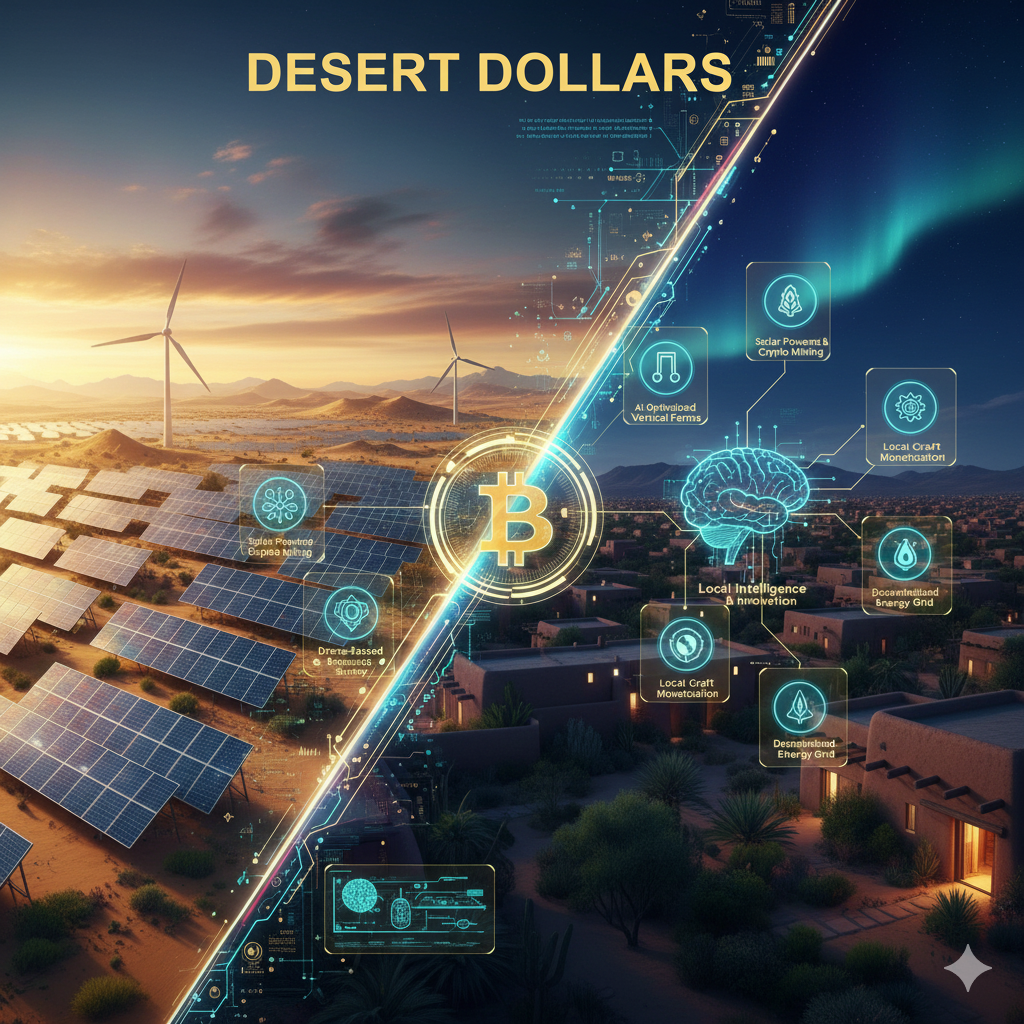
To the untrained eye, the desert is a liability. It is harsh, hot, and seemingly devoid of the resources that drive the modern economy. But to the strategic investor and the tech-savvy nomad, the desert represents a trifecta of undervalued assets: infinite energy (solar), limitless space, and deep isolation.
In the twenty-first century, the most profitable businesses are not necessarily those located in high-density urban centers. They are the businesses that can successfully lower their overhead to near zero. The desert landscape offers a unique economic proposition: Resource Arbitrage. By leveraging the abundance of sunlight and land to fuel energy-intensive technologies—specifically cryptocurrency mining and edge computing—the modern homesteader can transform a patch of dust into a decentralized financial engine.
The goal is to stop viewing the desert as a place to merely “survive” off-grid, and start viewing it as a platform to thrive on-chain. Here is how to monetize the unique physics of the arid environment.
The Energy Arbitrage: Solar-Powered Sovereign Wealth
The fundamental constraint of the digital economy is the cost of electricity. Whether you are training an AI model or securing the Bitcoin network, the profit margin is dictated by the spread between the value of the digital asset produced and the cost of the kilowatts consumed. In a city, you are paying utility rates that eat into your margins. In the desert, the energy is free—once you pay for the infrastructure.
This creates the perfect environment for Off-Grid Crypto Mining. By installing an oversized solar array—one that generates significantly more power than your daily living requirements—you can channel that “waste” energy into Application-Specific Integrated Circuits (ASICs).
This is not a hobby; it is Energy Arbitrage. You are capturing photons, converting them into electrons, and then converting those electrons into a globally traded store of value (like Bitcoin). Because your ongoing energy cost is near zero (sunlight is free), your operation remains profitable even when market prices dip, a resilience that grid-tied miners do not possess. You are essentially minting liquidity from the sun. The heat generated by the miners, usually a liability, can even be diverted to heat water or greenhouses during freezing desert nights, creating a closed-loop thermal system.
The Asset of Isolation: Security and The Experience Economy
Beyond energy, the desert offers a commodity that is becoming extinct in the modern world: silence and darkness.
Urban centers are plagued by light pollution, making the night sky a muddy gray. This scarcity turns the pristine desert sky into a monetizable asset for the Experience Economy. There is a high-margin market for Astrophotography and Stargazing Tours. City dwellers will pay a premium for a guided experience that reconnects them with the cosmos. This is not just pointing at the Big Dipper; it is about offering a technical service. By providing telescope rentals, power stations for long-exposure photography rigs (fed by your solar array), and expert guidance, you transform your land into a boutique observatory.
Furthermore, the isolation of the desert is a feature, not a bug, for Data Security. We are seeing the rise of “Edge Computing”—the need to process data closer to the source or in secure, decentralized locations. A remote, solar-powered server rack offers a unique value proposition: Sovereign Hosting. For clients obsessed with redundancy and disaster recovery, a server located miles from the nearest fault line, flood zone, or urban unrest target is highly attractive. While cooling is the engineering challenge here, innovative immersion cooling techniques (submerging servers in non-conductive liquid) allow for high-performance computing in high-heat environments without evaporating precious water.
The Logistics of Nothingness: Storage as a Service
Land in the city is priced by the square foot; land in the desert is priced by the acre. This disparity creates a massive opportunity for Arbitrage Storage.
Urban residents and businesses are drowning in “stuff” but lack the space to store it. RVs, boats, heavy construction machinery, and seasonal festival gear are expensive to park in the city. By erecting secure, weather-proof fencing and installing solar-powered CCTV systems, you can offer Long-Term Asset Storage at a fraction of the cost of a city lot while maintaining healthy profit margins. Because the land acquisition cost is so low, your Return on Investment (ROI) is rapid. By integrating IoT (Internet of Things) sensors on the gates and offering clients 24/7 remote monitoring via satellite internet, you provide a “high-tech” storage solution with “low-tech” overhead.
The Botanical Pivot: Permaculture Consulting
The desert is not dead; it is just dormant. There is a thriving market for Xeriscape and Permaculture Consulting. As water becomes scarcer globally, the skills required to grow food and medicine in arid environments are becoming high-value intellectual property.
If you have mastered the art of cultivating high-value crops like agave, prickly pear, or specific medicinal herbs using minimal water, you possess trade secrets. You can monetize this through Niche Consulting, teaching developers and other landowners how to implement swales, rainwater harvesting, and soil regeneration techniques. Furthermore, this expertise can be packaged into Digital Education. The “Prepper” and “Homesteader” markets are voracious consumers of information. A comprehensive video course on “Establishing a Water-Resilient Homestead” creates a passive income stream that scales globally, decoupling your income from your local economy entirely.
The Frontier of Finance: Land Tokenization
Finally, for the landowner who is truly forward-thinking, the blockchain offers a way to unlock the value of the land without selling it. This is the emerging field of Real World Asset (RWA) Tokenization.
Traditionally, land is an “illiquid” asset—it is hard to sell 10% of a field to raise cash. However, by using DeFi protocols to tokenize a portion of your land holdings, you can sell fractional ownership or “usage rights” to a global pool of investors. You might issue a token that grants the holder the right to camp on the land for one week a year, or a token that pays out a percentage of the profits from the solar mining operation. This allows you to raise capital for development without going to a bank, maintaining control while leveraging the liquidity of the global crypto markets.
The Mirage that Pays
The desert requires a shift in perspective. It is not a barren wasteland; it is a blank canvas for the appropriate technology.
By combining the abundance of solar energy with the efficiency of blockchain technology and the scarcity of open space, the modern desert dweller can build a portfolio of income streams that are resilient, decentralized, and highly profitable. You are not just living off the land; you are integrating the land into the digital future.