
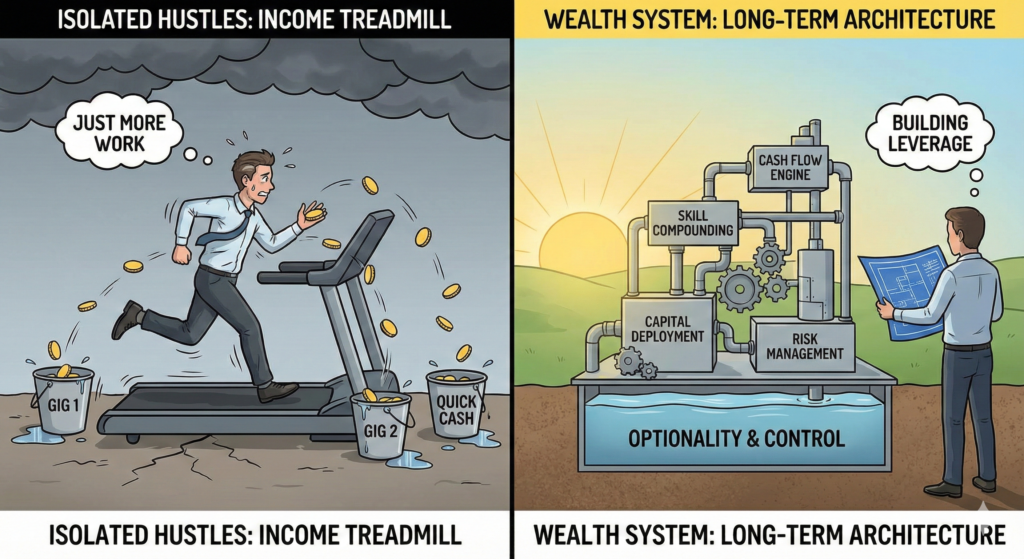
Most people think about side hustles as isolated income streams — something extra on top of a job, a way to make more money, or a temporary experiment. That perspective is understandable, but it’s also limiting.
When approached intentionally, side hustles are not just ways to earn more. They can become a cohesive wealth-building system — one that compounds skills, capital, optionality, and control over time.
This article reframes side hustles from short-term tactics into a long-term financial architecture.
Why Income Alone Is the Wrong Goal
Chasing income is seductive because it’s measurable and immediate. But income alone does not equal wealth.
Wealth is built from:
- Sustainable cash flow
- Capital accumulation
- Skill leverage
- Optionality
- Resilience to shocks
Many high-income individuals remain financially fragile because their income depends on a single source. A true wealth-building system reduces dependency and increases control.
From experience, side hustles work best when they are designed to change the structure of your finances, not just the amount coming in each month.
The System Mindset: How Wealth Is Actually Built
A system is more than a collection of parts. It’s how those parts interact.
A side hustle wealth system typically includes:
- Cash flow engines
- Skill compounding
- Capital deployment
- Risk management
- Optionality creation
Each element reinforces the others over time.
Isolated hustles produce income.
Integrated hustles produce leverage.
Cash Flow Is the Foundation, Not the Destination
Cash flow is the starting point.
Side hustles generate surplus cash that can be:
- Reinvested
- Used to reduce financial pressure
- Deployed into higher-leverage opportunities
However, cash flow without direction often leads to lifestyle inflation rather than wealth.
From experience, the role of early side hustle income is not freedom — it’s fuel.
Fuel for learning.
Fuel for capital accumulation.
Fuel for better opportunities.
Skill Compounding: The Invisible Engine
One of the most powerful — and underestimated — aspects of side hustles is skill compounding.
Side hustles often force you to learn:
- Sales and communication
- Decision-making under uncertainty
- Risk management
- Systems thinking
- Self-management
These skills compound across projects.
Even if one hustle fails, the skills carry forward, increasing the expected value of every future effort.
From experience, long-term wealth is built more reliably through skills that unlock opportunities than through any single income stream.
Capital as a Tool, Not a Goal
Capital is often treated as the endgame. In reality, it’s a tool.
Side hustles convert:
- Time → skills
- Skills → cash flow
- Cash flow → capital
- Capital → leverage
When capital is deployed with discipline, it accelerates growth. When deployed emotionally, it destroys progress.
In financial and crypto side hustles especially, capital must be treated as strategic inventory, not chips on a table.
Preserving capital preserves future opportunity.
Risk Management Is What Keeps the System Alive
Wealth-building systems don’t avoid risk — they control it.
Key principles include:
- No single point of failure
- Limited downside per decision
- Ability to survive drawdowns
- Flexibility to adapt
From experience, many people focus obsessively on returns and ignore survivability. But compounding only works if you stay in the game.
A system that can’t survive bad periods is not a wealth system — it’s a fragile bet.
Optionality: The Real Measure of Progress
Optionality is the ability to choose.
As a side hustle system matures, it should increase:
- Career options
- Income flexibility
- Negotiation power
- Lifestyle control
Optionality is what turns money into freedom.
From experience, the biggest shift happens when income is no longer tied to a single employer, client, or market condition. At that point, decisions become strategic rather than reactive.
Side Hustles as a Portfolio, Not a Collection
Wealth systems are built like portfolios.
A healthy side hustle portfolio includes:
- Different return drivers
- Different time horizons
- Different risk profiles
Examples:
- One stable, skill-based hustle
- One scalable, capital-based strategy
- One long-term asset (audience, IP, or brand)
The goal is not quantity — it’s balance and resilience.
Multiple hustles that fail together are not diversification.
The Compounding Effect of Patience
Time is the multiplier most people underestimate.
Small, well-managed side hustles compound through:
- Skill improvement
- Reputation growth
- Network effects
- Capital reinvestment
From experience, the gap between short-term and long-term thinkers widens dramatically after a few years. Those who rush often reset to zero repeatedly. Those who persist build momentum that’s hard to stop.
Wealth is rarely built explosively.
It’s built quietly, then visibly.
Lifestyle Design Is Part of the System
A side hustle wealth system should support life — not dominate it.
Key questions:
- Can this system scale without consuming all my time?
- Does it reduce stress over time?
- Can it adapt to life changes?
From experience, systems that ignore lifestyle eventually collapse under pressure. Sustainability is not a nice-to-have — it’s a requirement.
From Side Hustle to Personal Economy
At its highest level, a side hustle system becomes a personal economy.
You control:
- How money is earned
- How risk is taken
- How capital is allocated
- How time is valued
This is not about escaping work. It’s about owning the structure that governs your financial life.
From experience, this level of control is the true reward — far more than any single income milestone.
A Simple Long-Term Model
A practical long-term progression often looks like this:
- Start a skill-based side hustle
- Generate consistent surplus cash
- Build capital and decision skills
- Add scalable or capital-based strategies
- Integrate into a diversified system
- Optimize for sustainability and control
Each step builds on the last.
Skipping steps increases fragility.
Final Thoughts
Side hustles are not just income projects. They are wealth-building components.
When treated individually, they create noise.
When treated as a system, they create leverage.
The goal is not to maximize income this month.
The goal is to design a structure that compounds skills, capital, and optionality over years.
Trends will change.
Markets will cycle.
Tools will evolve.
A well-built side hustle system adapts — and continues to grow.
That is how side hustles stop being “side” projects and become a foundation for long-term wealth.