
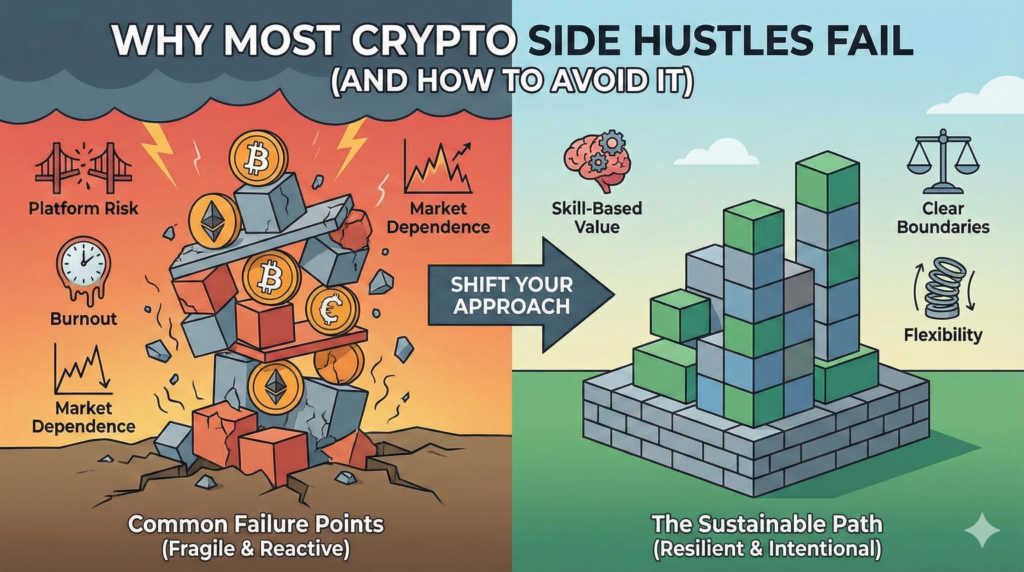
Crypto side hustles attract a lot of people — and lose most of them just as quickly.
At first, everything feels promising. New platforms, new opportunities, fast-moving communities, and the sense that something big is happening. Many people start with genuine curiosity and motivation.
Yet over time, the pattern repeats itself:
most crypto side hustles stall, collapse, or quietly fade away.
This doesn’t usually happen because people are lazy or unintelligent. It happens because crypto side hustles fail in very specific, predictable ways — and those failure points are often misunderstood or ignored.
This article looks at why most crypto side hustles fail, and more importantly, how to avoid the most common traps without relying on hype or unrealistic expectations.
The First Mistake: Confusing Opportunity With Sustainability
Crypto is full of opportunities — but opportunity is not the same as sustainability.
Many crypto side hustles are built on:
- Temporary inefficiencies
- Short-lived incentives
- Early-stage platforms
- Favorable market conditions
These can produce results early on, which creates confidence. The problem appears later, when the conditions that made the hustle viable begin to change.
From experience, most crypto side hustles don’t fail suddenly. They fail gradually, as the underlying opportunity disappears while effort stays the same.
Too Much Dependence on Market Conditions
One of the biggest reasons crypto side hustles fail is overexposure to market direction.
When income depends heavily on:
- Rising prices
- High volatility
- Constant liquidity
- Positive sentiment
…then the side hustle becomes fragile.
As soon as the market cools down, attention fades, incentives shrink, and results deteriorate.
From experience, side hustles that can only function in ideal market conditions rarely survive full market cycles.
Underestimating Psychological Pressure
Crypto side hustles place unusual psychological demands on people.
Constant monitoring, rapid changes, public sentiment swings, and visible gains and losses all compete for attention. Over time, this creates fatigue.
Common signs of psychological overload include:
- Checking dashboards compulsively
- Difficulty disconnecting
- Emotional reactions to small changes
- Reduced focus on other areas of life
From experience, many crypto side hustles fail not financially, but mentally. People burn out before the numbers ever collapse.
Platform and Rule Changes That Come Without Warning
Unlike traditional businesses, many crypto side hustles depend on platforms you don’t control.
Rules can change overnight:
- Incentives are removed
- Fees are adjusted
- Access is restricted
- Liquidity disappears
- Entire protocols are abandoned
A side hustle that depends on a single platform or mechanic becomes vulnerable to forces outside your control.
From experience, platform dependence is one of the most underestimated risks in crypto side hustles.
Treating Crypto Like a Shortcut
Another common failure point is mindset.
Many people approach crypto side hustles as shortcuts — a faster path compared to traditional work or skill-building.
This leads to:
- Rushing decisions
- Ignoring fundamentals
- Overcommitting capital
- Expecting results without structure
From experience, crypto amplifies mistakes. When shortcuts fail, they fail faster and harder.
Lack of Clear Process
Side hustles that survive usually have a process.
Crypto side hustles often don’t.
They rely on:
- Reacting to signals
- Following trends
- Chasing incentives
- Adapting constantly without structure
Without a clear process, it becomes impossible to evaluate whether a strategy is actually working — or just producing random outcomes.
From experience, randomness feels like progress until it doesn’t.
Scaling Too Early (or at All)
Many crypto side hustles fail when people try to scale them.
Increasing capital or effort often:
- Shrinks margins
- Increases slippage
- Raises emotional stakes
- Magnifies mistakes
What worked at a small scale may not survive growth.
From experience, crypto strategies often break not because they stop working, but because they are pushed beyond their natural limits.
Ignoring Opportunity Cost
Crypto side hustles are demanding in ways that aren’t always obvious.
They consume:
- Attention
- Mental energy
- Decision capacity
Over time, this creates opportunity cost.
People stay busy but stop building transferable skills, long-term systems, or more stable income sources.
From experience, the cost of a crypto side hustle is often paid in what doesn’t get built elsewhere.
How to Avoid These Failures
Avoiding failure doesn’t mean avoiding crypto. It means approaching it differently.
Some principles that tend to improve outcomes:
Focus on Skill-Based Value
Side hustles that rely on skills — writing, analysis, education, technical support — tend to be more resilient than those relying purely on market timing.
Limit Market Exposure
Reducing direct dependency on price movements lowers emotional and financial volatility.
Define Clear Boundaries
Clear limits on time, capital, and attention prevent the side hustle from taking over your life.
Expect Cycles, Not Stability
Crypto moves in cycles. Side hustles that assume constant growth are fragile by design.
Prioritize Reversibility
Strategies that can be paused, adjusted, or exited easily are safer than those that lock you in.
From experience, flexibility matters more than optimization.
When Failure Is Actually a Signal
Sometimes, a crypto side hustle fails because it should.
Not every idea deserves to survive. Not every opportunity fits every person or life stage.
Failure becomes useful when it:
- Clarifies risk tolerance
- Improves decision-making
- Refines judgment
- Reveals what doesn’t align anymore
From experience, people who learn to interpret failure as feedback — not defeat — tend to make better decisions over time.
A More Realistic Definition of Success
In crypto, success is often framed as:
- Maximum returns
- Constant growth
- Perfect timing
A more realistic definition looks different:
- Controlled exposure
- Skills gained
- Stress kept manageable
- Decisions improving over time
- Optionality preserved
From experience, sustainable involvement beats short-lived wins.
Final Thoughts
Most crypto side hustles fail for reasons that are predictable, structural, and avoidable.
They fail because:
- Conditions change
- Risk is misunderstood
- Attention is overextended
- Expectations are misaligned with reality
Avoiding failure doesn’t require perfection.
It requires awareness, boundaries, and patience.
Crypto side hustles can be valuable tools — but only when they are treated as part of a broader strategy, not as shortcuts or identities.
In crypto, longevity is often the real success metric.