
In the vast, glittering expanse of the digital economy, the eyes of most entrepreneurs are fixed on the horizon—chasing the next crypto pump, the next AI wrapper, or the next global dropshipping trend. They are looking for scale, for virality, and for the allure of the “internet money” lifestyle.
However, while the digital elite fight over pennies in saturated global markets, a massive, unserved economy sits right in their own zip codes. This is the Main Street Economy. The plumber, the dentist, the independent roofing contractor, and the boutique law firm. These businesses are cash-rich, operationally essential, and critically tech-starved.
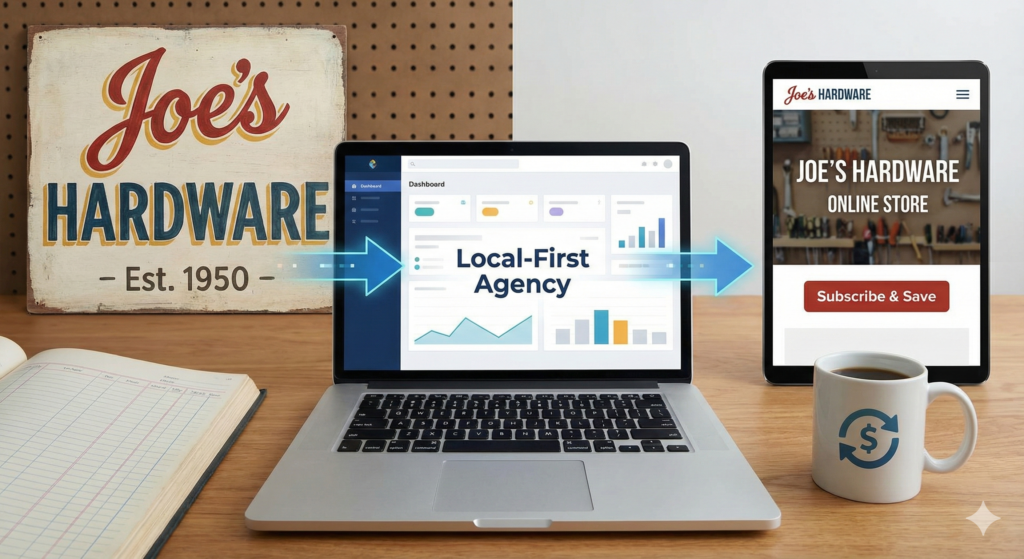
The “Local-First” Agency model is not about building flashy websites or winning design awards. It is about acting as a Digital Infrastructure Partner. It involves taking traditional, brick-and-mortar businesses and installing the digital plumbing they need to survive in 2026. The opportunity here is not in selling “marketing”; it is in selling operational efficiency. By bridging the gap between Silicon Valley tools and Main Street reality, you can build a stable, high-margin business founded on the holy grail of finance: Recurring Revenue.
Here is a strategic analysis of how to build a Local-First Agency that prioritizes retention over acquisition and utility over vanity.
The Failure of the Traditional Agency Model
To understand why the Local-First model works, we must first understand why the traditional “Creative Agency” model fails for small businesses.
Traditionally, an agency approaches a local business trying to sell a “Project.” They sell a $5,000 website or a $2,000 logo redesign. The problem with this model is the Feast or Famine Cycle. You hunt for a client, you kill the project, you eat, and then you starve until you find the next one. It is a hamster wheel of acquisition.
Furthermore, local business owners often resent these costs. A website feels like a sunk cost—a digital brochure that sits there doing nothing. It doesn’t demonstrably ring the cash register. The Local-First Agency flips this dynamic. Instead of selling a project, you sell a Subscription. You don’t sell a “website”; you sell a “Customer Acquisition System.” You shift the conversation from “How much does this cost?” to “How much money will this make me this month?”
The Product: Infrastructure as a Service (IaaS)
The modern local business does not need complex custom code. They need three specific things: Visibility, Trust, and Communication Speed. Your agency provides these via a tech stack that you manage, but they pay for. This concept is often called “Software with a Service” (SWaaS).
1. The Trust Engine: Automated Reputation ManagementFor a local business, Google Reviews are the currency of trust. A roofing company with 4.8 stars and 200 reviews will crush a competitor with 3.5 stars and 10 reviews, regardless of who is the better roofer. However, business owners are terrible at asking for reviews. They forget, or they feel awkward. Your agency sets up an automated system. When a job is marked “complete” in their CRM, the customer automatically receives a text message: “Hi [Name], thanks for choosing us! Would you mind taking 10 seconds to tap this link and rate your experience?” This simple automation can double a company’s review count in 90 days. This is a quantifiable metric. You can show the client: “We got you 40 new 5-star reviews this month.” That is value they will happily pay a monthly retainer to keep.
2. The “Speed to Lead” Fix: Missed Call Text-Back The single biggest source of revenue leakage for local businesses is the unanswerable phone. A customer calls a plumber with an emergency. The plumber is under a sink and doesn’t answer. The customer does not leave a voicemail; they call the next plumber on Google. That missed call cost the plumber a $1,000 job. Your agency implements Missed Call Text-Back Automation. The moment a call goes unanswered, the system instantly sends a text: “Sorry I missed you! I’m currently on a job site. How can I help you?” This engages the customer immediately. It stops them from calling a competitor. It creates a text thread where the plumber can close the deal later. This single feature often pays for your entire agency fee in the first week.
3. Digital Real Estate: Google Business Profile (GBP) Optimization Forget trying to rank for “Best Dentist in the World.” Local SEO is about ranking in the “Map Pack”—the three businesses that show up on the Google Maps preview for a local search. Your monthly service involves managing this profile: uploading geotagged photos of recent work, posting updates, answering Q&A, and fighting spam listings. You are the groundskeeper of their digital storefront.
The Economic Model: The White-Label Advantage
The genius of the Local-First Agency is that you do not need to build this software. Platforms like GoHighLevel (HighLevel) have already built it. They allow you to “White Label” their software.
This means you pay a flat fee to the software provider, put your own brand and logo on it, and resell it to your clients at your own price point.
- Your Cost: ~$297 – $497/month (flat fee for unlimited clients).
- Client Price: $297 – $497/month (per client).
The math creates massive leverage.
- With 1 client, you break even.
- With 10 clients, you profit ~$4,000/month.
- With 50 clients, you profit ~$24,000/month.
Because the software handles the heavy lifting (sending the texts, managing the reviews), your fulfillment time is low. You are not trading hours for dollars; you are trading access for dollars.
The Psychology of the Local Sale
Selling to a plumber is different from selling to a startup founder. They have high “BS detectors.” They hate jargon. They value relationships.
To succeed, you must adopt the persona of the Blue-Collar Consultant. Do not talk about “algorithms,” “conversion rate optimization,” or “API integrations.” Talk about “calls,” “jobs,” and “reputation.”
- Bad Pitch: “We will optimize your omnichannel funnel to decrease CAC.”
- Good Pitch: “We will install a system that texts customers back when you miss a call so you don’t lose the job to the next guy.”
Furthermore, your geographic proximity is a massive competitive advantage (or “moat”). A local business owner has likely been burned by a faceless agency in a different time zone. The fact that you can walk into their shop, shake their hand, and look them in the eye creates a level of trust that a remote competitor cannot replicate. You are a neighbor, not a vendor.
Churn Reduction: The “Sticky” Service
The bane of the agency world is Churn—clients leaving after a few months. In the traditional model, once the website is built, the client feels they no longer need you. In the Local-First SWaaS model, you are Sticky. You own the phone number they text from. You manage the database where their leads live. You control the flow of reviews. To fire you is to turn off their operational lights. As long as the system works—as long as the phone rings and the reviews come in—the client views your monthly invoice as a utility bill, essential for doing business, rather than a discretionary marketing expense.
The Stability of Main Street
While the global tech economy fluctuates with interest rates and VC funding, the local economy remains remarkably resilient. Pipes still burst. People still get toothaches. Roofs still leak. These businesses are not going anywhere. By positioning yourself as the essential digital partner to the businesses that run your community, you are building a revenue stream backed by the most stable assets in the economy: real-world needs. The Local-First Agency is not a “get rich quick” scheme. It is a “get wealthy steadily” play. It is about building a portfolio of boring, profitable, long-term relationships that compound over time.