
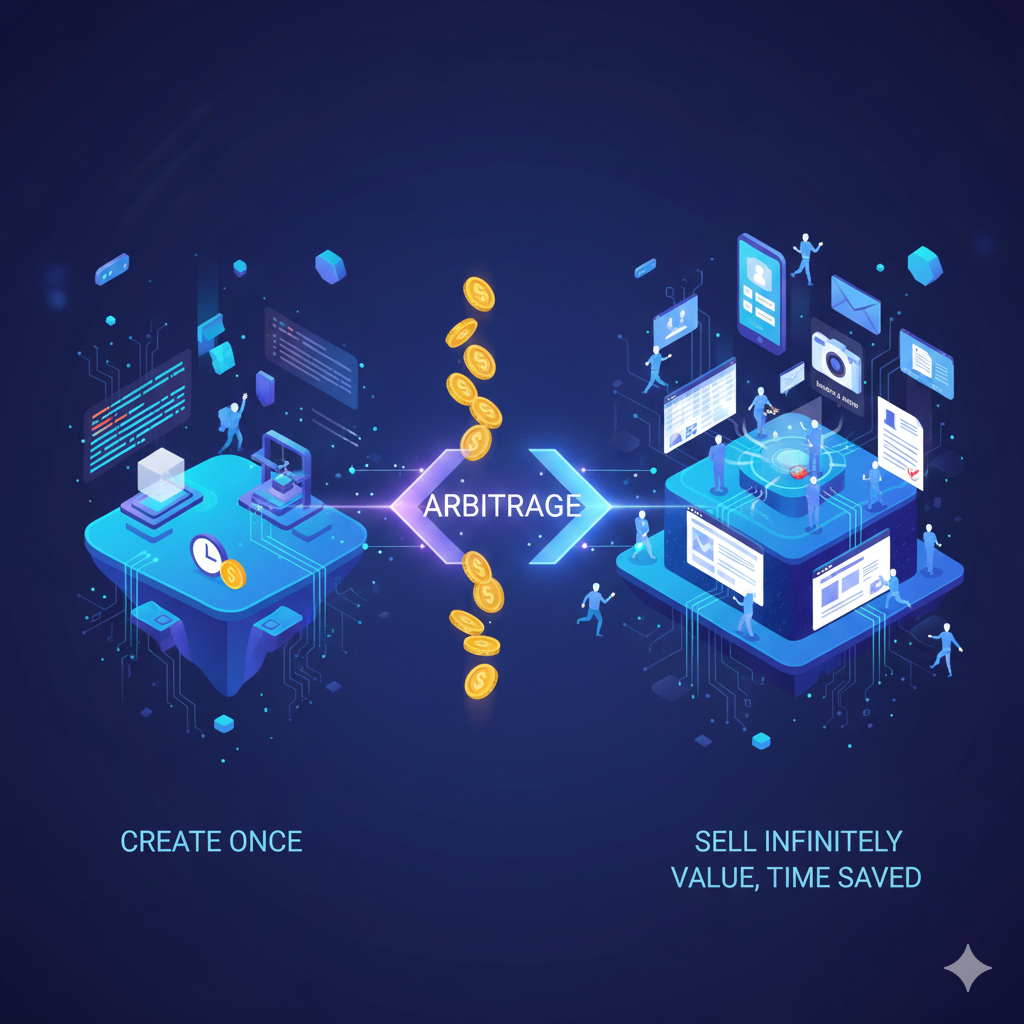
The fundamental law of the traditional economy is the exchange of time for money. It is a linear equation, and for the ambitious entrepreneur, it is a prison. If you stop working, the income stops. However, the digital economy operates on a completely different set of physics: the law of Zero Marginal Cost.
Once a digital asset—a spreadsheet, a design template, a code snippet—is created, the cost to replicate and sell it to the second customer, or the thousandth, is effectively zero. This creates a window for Digital Asset Arbitrage. You are not arbitraging price discrepancies between markets; you are arbitraging the value of time.
In the modern business landscape, speed is the only currency that matters. A freelance graphic designer does not want to spend ten hours building a client onboarding packet; they want to download one that works immediately. A startup founder does not want to learn the syntax of complex financial modeling; they want to buy a plug-and-play P&L sheet.
For the entrepreneur with a shoestring budget—let’s say, under $100—the goal is not to build a massive software company. The goal is to become a supplier of Operational Efficiency. You invest your intellectual capital once to build a high-utility asset, and you sell it infinitely. Your $100 is not for inventory; it is for the “digital storefront” (hosting, branding, and design tools).
Here is a strategic analysis of how to build a portfolio of high-leverage digital assets that flip time-savers for profit.
The Architect of Order: The Notion Ecosystem
We are living through a crisis of digital organization. Remote workers and freelancers are drowning in browser tabs, scattered Google Docs, and disconnected tools. They are desperate for a “Second Brain.”
Notion has emerged as the operating system for this demographic, but its blank-slate nature is intimidating. Building a relational database that connects client projects to invoices and task lists requires a specific type of systems thinking that most creatives lack. This creates a massive market for System Templates. You are not selling a “planner”; you are selling an operational workflow. By spending a weekend constructing a “Freelancer CRM & Project Tracker,” you are building a software product without writing code. The arbitrage here is psychological. The customer buys your $25 template not just for the database, but because they believe the template contains the discipline they lack. They are buying a better version of themselves. With a Canva Pro subscription (part of your $100 budget) to design high-converting product thumbnails, and a free Gumroad account, your overhead is negligible. You build the system once, and it serves as a passive revenue engine for years.
Financial Engineering: The Spreadsheet as Software
For the vast majority of small business owners, Excel is terrifying. Yet, it remains the backbone of global finance. If you possess the ability to make a spreadsheet “dance”—using macros, VLOOKUPs, and conditional formatting—you are sitting on a goldmine of intellectual property.
The Google Sheets FinTech Library model relies on the fact that business owners will happily pay $50 to avoid the frustration of a broken formula. A “Real Estate Investment Analysis Model” or a “Cryptocurrency Tax FIFO Calculator” is a high-utility tool. You are selling Logic as a Service. When you package a complex depreciation schedule into a user-friendly sheet where the user only needs to input yellow cells, you have effectively built a software application. The key here is specificity. Do not sell a “Budget.” Sell a “Construction Contractor Job Costing Estimator.” The more specific the pain point, the higher the price elasticity. You are leveraging your domain expertise to save the client from hiring a $200/hour consultant to build the same tool.
The AI Whisperer: Prompt Engineering Assets
We are in the early, chaotic days of the Artificial Intelligence revolution. While millions have access to tools like ChatGPT and Midjourney, very few know how to control them. Most users get generic, hallucinated, or poor-quality results because they treat the AI like a search engine rather than a reasoning engine.
This has given rise to the Prompt Asset Economy. A prompt is no longer just a sentence; it is a piece of code. A “chain-of-thought” prompt that forces an AI to act as a Senior SEO Strategist, audit a website, and output a table of keywords is a valuable piece of IP. By creating Niche Prompt Packs—for example, “50 Midjourney Prompts for luxury Real Estate Architectural Renderings”—you are bridging the gap between the tool’s potential and the user’s skill. You invest the time to test, refine, and perfect the syntax. You package these text strings into a PDF or a digital library. The customer pays for the shortcut. They pay to skip the 100 failed attempts you went through to get the perfect result.
The Visual Trust Broker: Niche Branding Kits
In the freelance economy, “looking the part” is half the battle. A wedding photographer or a life coach can charge double if their brand aesthetic feels premium. However, hiring a brand designer costs thousands.
This is where High-Value Canva Template Bundles thrive. Unlike generic templates found in the Canva library, you are creating Cohesive Brand Systems. You are offering a “Wedding Photographer Client Experience Kit”—a matching set of Instagram Story templates, a Pricing PDF, a Welcome Guide, and a Contract cover. You are arbitraging the “Agency Look.” By utilizing your Canva Pro subscription to access premium assets and fonts, you create a bundle that allows a solopreneur to look like an established agency in ten minutes. The value proposition is speed and status. You are selling confidence.
The Compliance Shield: Documentation and Legal Kits
Fear is a powerful motivator. New freelancers and consultants are terrified of scope creep, non-payment, and legal liability. They know they need a contract, but they can’t afford a $400/hour lawyer.
The Freelancer Compliance Kit is a high-trust digital asset. By compiling and designing professional Scope of Work templates, Independent Contractor Agreements, and Late Payment Notices, you provide a “Business in a Box.” Note: While you must be careful not to provide legal advice, you can curate standard industry templates. The value here is Risk Mitigation. A freelancer buys your “Client Onboarding Kit” because it signals to their client that they are a professional who takes their business seriously. You are selling the infrastructure of professionalism.
The Data Arbitrage: Curated Information
Finally, in an age of information overload, curation is a service. Information is free, but organized, verified information is expensive.
Consider the Hyper-Specific Lead List. A B2B salesperson would kill for a list of “The Top 100 Shopify Stores in Texas utilizing Email Marketing Software.” Finding that data manually takes weeks. If you use your time (and perhaps a trial of a data-scraping tool) to compile, verify, and clean that list, you have created a high-value asset. Similarly, Niche Stock Photography exploits the gaps in major stock sites. AI can generate generic images, but it cannot generate authentic photos of a specific local coffee shop’s workflow or a specific type of industrial machinery repair. If you capture these images, you own a monopoly on that specific visual data.
The Investment Thesis
The beauty of the $100 startup model is that it forces you to focus on value rather than infrastructure. You cannot hide behind expensive software or office space. You must create something that solves a problem so acutely that a stranger is willing to pull out their credit card to download it.
You are acting as a Time Arbitrageur. You spend ten hours of your time to save ten thousand people one hour each. In doing so, you decouple your income from your clock, transforming yourself from a laborer into an owner of digital capital.