
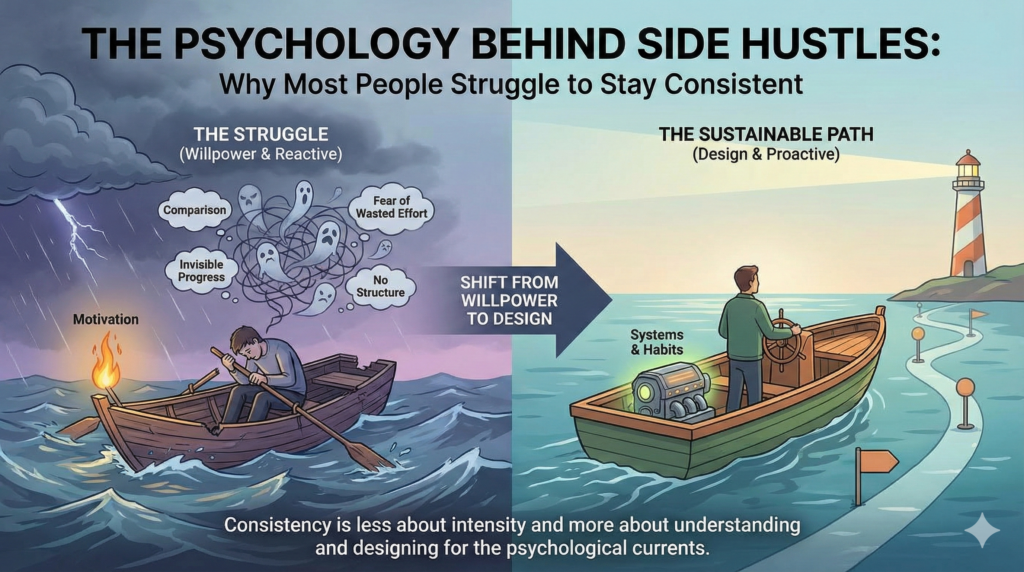
Starting a side hustle is rarely the hard part.
Most people begin with motivation, curiosity, and a clear reason — extra income, flexibility, or a sense of control. The real challenge appears later, often quietly:
staying consistent once the initial excitement fades.
This isn’t a discipline problem. And it’s not a lack of intelligence or ambition. In most cases, it’s psychological.
This article explores the psychological forces that shape side hustles, why so many people struggle to stay consistent, and how understanding these patterns leads to better — and calmer — decisions over time.
Motivation Is Temporary (And That’s Normal)
Motivation is often treated as something you either have or don’t have.
In reality, motivation is situational. It spikes at the beginning, when:
- The idea feels new
- Progress feels fast
- Possibility feels open
Over time, motivation fades — not because something is wrong, but because novelty disappears.
From experience, people who expect motivation to last tend to quit early. People who expect it to fade build systems instead.
Why Side Hustles Feel Harder Than Regular Jobs
One psychological challenge of side hustles is the lack of structure.
Jobs provide:
- External deadlines
- Clear expectations
- Social accountability
- Immediate feedback
Side hustles remove most of that.
You decide:
- When to work
- What matters
- Whether progress is “enough”
- When to stop or continue
From experience, this freedom is empowering — but also mentally demanding. Decision fatigue becomes real very quickly.
The Problem of Invisible Progress
Many side hustles suffer from delayed feedback.
Effort doesn’t immediately translate into results. Progress is often:
- Non-linear
- Invisible
- Hard to measure
- Easy to doubt
From experience, this gap between effort and reward creates psychological friction. People aren’t discouraged by hard work — they’re discouraged by uncertain payoff.
Comparison Quietly Undermines Consistency
Side hustles are rarely built in isolation.
People compare themselves to:
- Online success stories
- Metrics shared publicly
- People at completely different stages
This comparison creates unrealistic benchmarks.
From experience, comparison shifts focus away from progress and toward validation. Once that happens, consistency becomes fragile.
The Emotional Weight of “Optional” Work
Side hustles are optional — and that’s part of the problem.
When work is optional:
- Skipping it feels harmless
- Delays feel justified
- Urgency disappears
From experience, optional commitments require stronger internal clarity than mandatory ones. Without a clear “why,” optional work slowly dissolves.
Fear of Wasted Effort
A subtle psychological barrier is fear of wasting time.
People hesitate to:
- Commit fully
- Choose a direction
- Stay consistent
Because they worry about choosing the “wrong” path.
From experience, this leads to endless preparation and constant switching — which feels productive but prevents momentum.
Identity Plays a Bigger Role Than Expected
Side hustles often become tied to identity.
People don’t just say:
“I’m working on a side hustle.”
They start to think:
“I’m the kind of person who does this.”
When progress stalls, it feels personal.
From experience, separating identity from outcomes makes persistence healthier and more sustainable.
Why Burnout Happens Faster Than Expected
Side hustle burnout often surprises people.
It happens because:
- Work bleeds into rest
- Boundaries aren’t defined
- Mental load stays constant
- There’s no clear “off” switch
From experience, burnout isn’t caused by effort alone — it’s caused by effort without recovery.
Consistency Is More About Design Than Willpower
Willpower is unreliable.
Consistency improves when:
- Decisions are reduced
- Work sessions are defined
- Scope is limited
- Expectations are realistic
From experience, side hustles that rely on willpower eventually stall. Side hustles that rely on design tend to survive.
Reframing What “Success” Looks Like
Many people quit side hustles because they believe they’re failing — even when they’re not.
Success doesn’t always mean:
- Fast growth
- High income
- Constant progress
Sometimes success means:
- Learning clarity
- Building habits
- Gaining confidence
- Maintaining balance
From experience, redefining success reduces pressure and improves longevity.
A Healthier Psychological Approach
A more sustainable mindset includes:
- Accepting slow progress
- Expecting emotional cycles
- Normalizing doubt
- Measuring effort, not outcomes
- Allowing rest without guilt
From experience, calm consistency beats intense bursts of effort.
Why Most People Quit (And Why That’s Not Always Bad)
Many people quit side hustles — and that’s not always a failure.
Sometimes quitting:
- Clarifies priorities
- Reveals misalignment
- Prevents burnout
- Creates space for better ideas
From experience, the problem isn’t quitting — it’s quitting without learning why.
Final Thoughts
Side hustles are psychological challenges disguised as financial ones.
The hardest part is rarely skill or opportunity. It’s managing uncertainty, self-doubt, and motivation over time.
Understanding the psychology behind side hustles doesn’t guarantee success — but it dramatically improves decision quality.
And in the long run, better decisions matter far more than bursts of enthusiasm.