
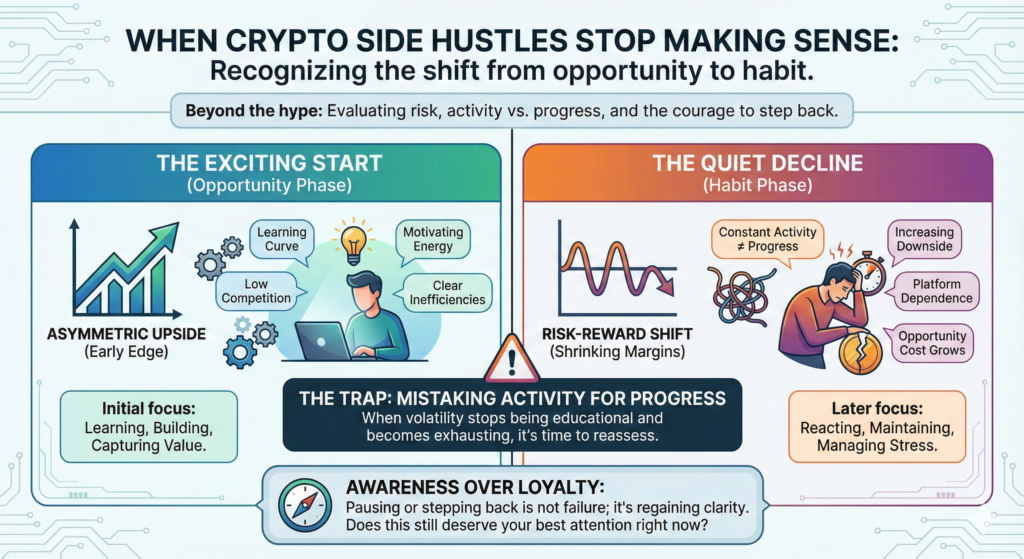
Crypto side hustles often start with excitement.
New tools, new platforms, new opportunities. The feeling that you’re early, learning something modern, and potentially building an edge. For a while, that energy is motivating.
But crypto side hustles also have a unique problem:
it’s often hard to tell when the opportunity has passed, and habit has taken over.
This article is not about quitting crypto altogether. It’s about understanding when a crypto-related side hustle stops making sense, and how to evaluate that moment without panic, ego, or sunk-cost thinking.
Crypto Side Hustles Are Not Like Traditional Ones
Most side hustles behave in predictable ways.
Crypto side hustles don’t.
They are influenced by:
- Market cycles
- Platform changes
- Regulation
- Sentiment
- Liquidity
- Attention
What works during one phase of the market may quietly stop working later — even if your effort stays the same.
From experience, many people don’t fail at crypto side hustles because they lack skill, but because they stay too long in a model that no longer fits the environment.
The Danger of Confusing Activity With Progress
Crypto side hustles often feel productive.
There are dashboards to check, numbers moving, communities talking, updates to follow. Activity is constant.
But activity is not the same as progress.
A crypto side hustle may no longer make sense if:
- You’re doing more work for the same results
- Risk is increasing while rewards stay flat
- You’re constantly reacting instead of building
- Most gains come from luck, not process
From experience, crypto is especially good at creating the illusion of momentum long after the underlying edge has disappeared.
When the Risk-Reward Balance Shifts
One of the clearest signals is a change in risk-reward balance.
Early on, many crypto side hustles offer:
- Low competition
- Clear inefficiencies
- Asymmetric upside
Over time, those conditions change.
A side hustle may stop making sense when:
- Margins shrink
- Capital requirements increase
- Downside grows faster than upside
- Mistakes become more costly
From experience, many people keep going not because the upside is attractive, but because they’ve already adapted their life around the hustle.
Emotional Attachment Is Stronger in Crypto
Crypto side hustles tend to become part of identity.
You’re not just freelancing or selling a service — you’re “in crypto”. That identity makes it harder to step back and reassess.
Common thoughts include:
- “I just need one more cycle”
- “The market will turn again”
- “I’ve already learned so much”
- “Quitting now feels wrong”
From experience, identity-based attachment delays rational decisions more than bad data ever does.
When Volatility Stops Being Educational
Volatility can be useful.
Early on, it teaches:
- Risk management
- Emotional control
- Position sizing
- Decision-making under pressure
But volatility stops being useful when:
- It dominates your attention
- It causes constant stress
- It no longer leads to learning
- It affects unrelated areas of life
From experience, when volatility becomes exhausting instead of instructive, it’s often a sign the side hustle needs to change — or pause.
Platform Dependence Is a Quiet Red Flag
Many crypto side hustles depend heavily on:
- Specific platforms
- Specific protocols
- Temporary incentives
- Algorithmic rules you don’t control
A side hustle may stop making sense when:
- Small rule changes destroy profitability
- You’re forced to chase incentives constantly
- Stability depends on factors you can’t influence
From experience, platform dependence increases fragility — especially in crypto, where changes can be sudden and irreversible.
The “It Still Works, Technically” Trap
One of the hardest situations is when a crypto side hustle still works — but barely.
Income hasn’t dropped to zero.
It’s just… thinner. More stressful. Less predictable.
This creates a trap:
- It’s not bad enough to quit easily
- It’s not good enough to feel confident
From experience, this gray zone is where people waste the most time, because the decision is uncomfortable and ambiguous.
Opportunity Cost Hits Harder Over Time
Crypto side hustles often consume high-quality attention.
Monitoring markets, reacting quickly, staying informed — all of this uses cognitive energy.
A side hustle may stop making sense when:
- It crowds out deeper skill development
- It prevents longer-term projects
- It keeps you reactive instead of strategic
From experience, opportunity cost becomes visible only in hindsight — which is why it’s often ignored in the moment.
Financial Dependence Changes the Question
If crypto side hustle income is meaningful, the decision is more complex.
It’s no longer:
“Should I stop?”
It becomes:
- Can I reduce exposure?
- Can I simplify?
- Can I stabilize instead of optimize?
- Can I prepare an exit?
From experience, gradual transitions in crypto are safer than abrupt exits driven by fear or exhaustion.
Pausing Is an Underrated Option
Not every crypto side hustle needs to be abandoned.
Sometimes the right move is to:
- Pause active involvement
- Reduce capital at risk
- Step back from constant monitoring
- Preserve knowledge without pressure
From experience, pausing often restores perspective — and reveals whether the hustle is still valuable or just familiar.
What You Keep Even If You Stop
Ending or reducing a crypto side hustle doesn’t erase what you gained:
- Understanding of markets
- Risk awareness
- Technical literacy
- Pattern recognition
Those skills transfer surprisingly well.
From experience, many people leverage crypto experience later in more stable or structured contexts.
A Better Question to Ask
Instead of asking:
“Will this work again?”
Ask:
“Does this still deserve my best attention right now?”
That question shifts the focus from hope to alignment.
Final Thoughts
Crypto side hustles exist in fast-changing environments.
What made sense once may quietly stop making sense later — even if the story hasn’t changed.
Recognizing that moment is not failure.
It’s awareness.
The goal is not to stay in crypto side hustles forever.
The goal is to use them when they make sense, and step back when they don’t.
Clarity, not loyalty, is what keeps crypto involvement healthy over the long term.