
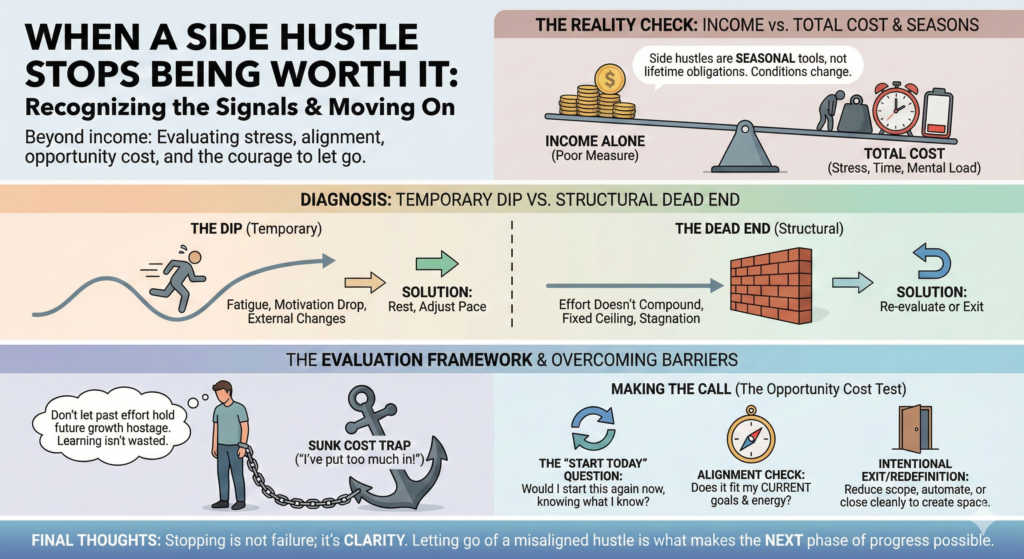
Side hustles are usually discussed in terms of starting, growing, and scaling.
Much less attention is paid to a quieter — and often more uncomfortable — question:
When does a side hustle stop being worth it?
This question doesn’t usually appear at the beginning. It shows up later, after effort has already been invested, habits have formed, and identity starts to get involved.
And that’s precisely why it’s hard to answer honestly.
This article explores how to recognize when a side hustle no longer serves its purpose — and how to think about that decision without guilt, fear, or unnecessary attachment.
The Problem With “Never Quit” Advice
A lot of advice around side hustles revolves around persistence.
Don’t quit too early.
Stick it out.
Push through resistance.
Persistence matters. But blind persistence is not the same as commitment.
From experience, the idea that quitting is always a failure often traps people in projects that quietly drain time, energy, and focus — without delivering meaningful value anymore.
Sometimes, the most rational decision is not to push harder, but to re-evaluate.
Side Hustles Have Seasons
One overlooked truth is that side hustles are often seasonal.
They fit a particular phase of life:
- A certain schedule
- A certain energy level
- A specific financial need
- A specific motivation
What made sense two years ago may not make sense now.
From experience, problems arise when people expect a side hustle to stay relevant forever — instead of allowing it to evolve or end.
Income Alone Is a Poor Measure
Many people judge a side hustle only by income.
That’s understandable, but incomplete.
A side hustle can generate income and still not be worth it if:
- Stress is increasing faster than earnings
- Time demands keep expanding
- It crowds out better opportunities
- It creates ongoing mental load
From experience, the real cost of a side hustle is often paid in attention and energy, not money.
Signs a Side Hustle May No Longer Be Worth It
Rarely is there a single breaking point. More often, it’s a pattern.
Common signals include:
- Progress has plateaued despite consistent effort
- The work feels heavier, not lighter
- You’re maintaining, not building
- Opportunity cost keeps growing
- You avoid working on it unless forced
None of these mean you’ve failed. They mean conditions have changed.
The Difference Between a Dip and a Dead End
Not all slow periods mean it’s time to stop.
There’s an important difference between:
- A temporary dip
- A structural dead end
A dip often comes with:
- Fatigue
- Temporary loss of motivation
- Short-term external changes
A dead end feels different:
- Effort no longer compounds
- Improvements don’t change outcomes
- The ceiling feels fixed
From experience, dead ends feel stagnant, not just difficult.
Emotional Attachment Makes Decisions Harder
Side hustles are personal.
They represent effort, identity, and often sacrifice. That makes it hard to assess them objectively.
Common emotional traps include:
- “I’ve already put so much into this”
- “What if it works later?”
- “Quitting means I wasted time”
- “I should be grateful it earns anything”
From experience, sunk cost thinking keeps people stuck longer than logic ever would.
Time spent learning is rarely wasted — even if the project ends.
When the Side Hustle Starts Limiting Growth
A subtle sign a side hustle may no longer be worth it is when it blocks better options.
This can happen when:
- It consumes peak energy
- It prevents skill development elsewhere
- It crowds out rest or recovery
- It keeps you busy but not progressing
From experience, being busy can feel productive — even when it’s actually limiting growth.
Financial Dependence Changes the Equation
The decision becomes more complex when a side hustle contributes meaningfully to income.
In that case, the question isn’t:
“Should I quit?”
It’s:
“Is this still the best use of my effort right now?”
Sometimes the answer is:
- Reduce involvement
- Stabilize instead of grow
- Use it as a temporary buffer
- Prepare an exit rather than an abrupt stop
From experience, gradual transitions lead to better outcomes than sudden decisions driven by frustration.
The Opportunity Cost Test
A useful way to evaluate a side hustle is through opportunity cost.
Ask:
- What am I not doing because of this?
- If I freed this time, where would it go?
- Would I start this again today, knowing what I know now?
From experience, that last question often brings clarity — even if the answer is uncomfortable.
Stopping Is Not the Same as Failing
Ending a side hustle doesn’t erase what it provided:
- Skills
- Confidence
- Income
- Perspective
Most progress is transferable.
From experience, people who allow themselves to end projects cleanly often move forward faster than those who drag them indefinitely.
How to End a Side Hustle Intentionally
If you decide a side hustle is no longer worth it, how you exit matters.
An intentional exit might include:
- Reducing commitments gradually
- Documenting what you learned
- Preserving useful assets
- Closing loops cleanly
This creates closure — and space.
From experience, intentional endings feel empowering, not regretful.
Sometimes the Right Move Is Redefinition
Not every side hustle needs to be ended. Some need to be redefined.
That can mean:
- Lowering expectations
- Reducing scope
- Automating or simplifying
- Turning it into maintenance mode
From experience, redefining often restores balance without forcing a full exit.
A Healthier Question to Ask
Instead of asking:
“Is this side hustle worth it?”
Ask:
“Is this still aligned with my current goals and constraints?”
Alignment changes over time. That’s normal.
From experience, decisions based on alignment age better than decisions based on guilt or fear.
Final Thoughts
Side hustles are tools — not obligations.
They exist to serve a purpose. When that purpose changes, it’s reasonable to adjust or let go.
Continuing something simply because you started it is rarely a good long-term strategy.
The ability to reassess, adapt, and move on is not a weakness.
It’s a sign of clarity.
And often, letting go of a side hustle is not the end of progress —
it’s what makes the next phase possible.