
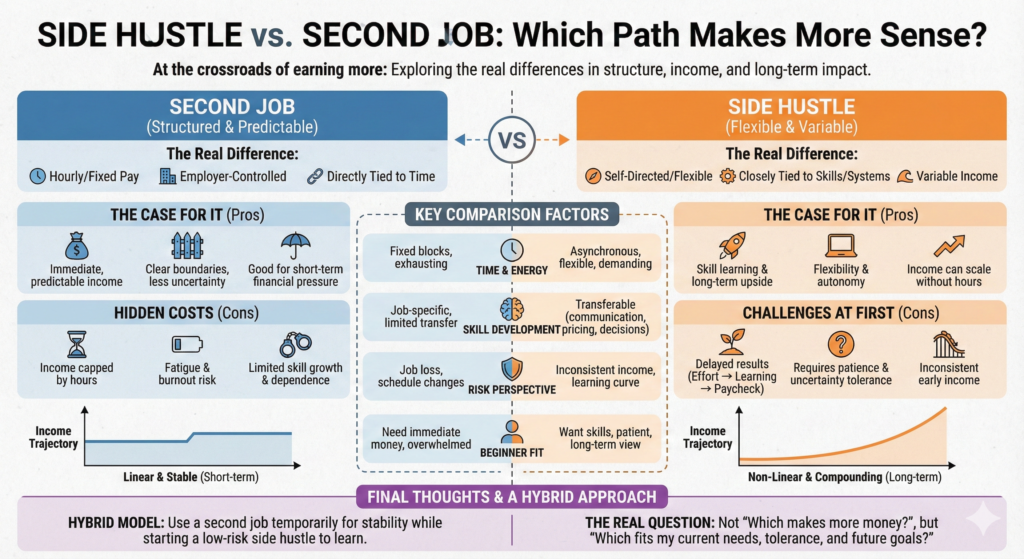
At some point, many people reach the same crossroads.
They want to earn more money, but their main job already takes most of their time and energy. The obvious question appears:
Should I start a side hustle, or should I just get a second job?
On the surface, both options seem similar. More work equals more money. But in practice, they are very different paths, with different risks, rewards, and long-term consequences.
This article explores the real differences between a side hustle and a second job, without hype, and without pretending that one option is always better than the other.
First, What Is the Real Difference?
A second job is usually:
- Hourly or fixed-pay work
- Structured and predictable
- Controlled by an employer
- Directly tied to time worked
A side hustle is usually:
- Self-directed
- Flexible in structure
- Variable in income
- Closely tied to skills, systems, or ownership
The key difference is not income at the beginning — it’s how the income behaves over time.
The Case for Getting a Second Job
Let’s start with the option many people choose first.
A second job makes sense when:
- You need immediate, predictable income
- You don’t want to make decisions or manage uncertainty
- Your schedule is already rigid
- You prefer clear boundaries between work and personal time
From a purely practical standpoint, second jobs offer clarity. You know how much you will earn per hour, when you will be paid, and what is expected from you.
For short-term financial pressure — debt, unexpected expenses, temporary goals — this can be the right choice.
There is nothing wrong with choosing certainty over experimentation.
The Hidden Costs of a Second Job
However, second jobs come with limitations that are often ignored.
The most obvious one is time.
Your income is capped by the number of hours you can physically work.
Less obvious costs include:
- Fatigue and burnout
- Reduced recovery time
- Limited skill growth
- Dependence on employers
From experience, people often underestimate how exhausting it is to maintain two jobs long term. What feels manageable for a few months can become unsustainable over a year.
The Case for Starting a Side Hustle
A side hustle usually starts slower, but it operates under different rules.
A side hustle makes sense when:
- You are willing to learn new skills
- You can tolerate some uncertainty
- You want flexibility
- You care about long-term upside
Unlike a second job, a side hustle can:
- Improve with experience
- Become more efficient over time
- Generate income without proportional increases in hours
From experience, side hustles reward problem-solving and persistence, not just availability.
Why Side Hustles Feel Harder at First
One reason many people quit side hustles early is psychological.
With a second job:
- Effort → paycheck is clear
With a side hustle:
- Effort → learning → delayed results
This delay can feel discouraging, especially if you compare it to the immediate income of a second job.
From experience, side hustles require patience and tolerance for ambiguity — two skills that are rarely taught but extremely valuable.
Income Stability: Short-Term vs Long-Term
In the short term, a second job almost always wins.
But over the long term, the picture changes.
Second job income:
- Stable
- Linear
- Limited by time
Side hustle income:
- Unstable early on
- Non-linear
- Influenced by systems and leverage
Many side hustles never replace a salary — and that’s okay. Others slowly evolve into meaningful income sources because skills and systems compound.
Skill Development: An Underrated Factor
One major difference between the two options is skill development.
Most second jobs:
- Improve job-specific skills
- Rarely transfer beyond that role
Side hustles often develop:
- Communication skills
- Pricing and negotiation
- Decision-making under uncertainty
- Basic business thinking
- Self-discipline
From experience, these skills tend to carry over into other areas of life and work, even if the side hustle itself changes.
Risk: Financial vs Structural
People often say side hustles are “riskier,” but risk depends on perspective.
Second job risks:
- Job loss
- Schedule changes
- Physical exhaustion
- Limited flexibility
Side hustle risks:
- Inconsistent income
- Learning curve
- Emotional uncertainty
From experience, side hustle risk can often be controlled by starting small and keeping costs low. Structural risk (depending entirely on employers) is harder to diversify.
Time and Energy Considerations
Not all hours are equal.
A second job usually requires:
- Fixed blocks of time
- Being present at specific hours
- Limited flexibility
A side hustle often allows:
- Asynchronous work
- Time-shifting
- Working in shorter sessions
For people with unpredictable schedules, side hustles can fit more naturally — but they also demand self-management.
Which One Is Better for Beginners?
There is no universal answer.
A second job may be better if:
- You need money immediately
- You don’t want uncertainty
- You are already mentally overloaded
A side hustle may be better if:
- You want to build skills
- You can be patient
- You value autonomy
- You’re thinking long-term
From experience, many people move from one option to the other at different life stages — and that’s completely normal.
A Hybrid Approach That Often Works
An overlooked option is using a second job temporarily while starting a low-risk side hustle.
This approach:
- Reduces financial pressure
- Allows learning without desperation
- Keeps options open
From experience, this hybrid model often leads to better decisions and lower stress.
Common Mistakes When Choosing
Some common mistakes include:
- Choosing based on hype
- Ignoring personal energy limits
- Overestimating available time
- Expecting side hustles to behave like jobs
The best choice is rarely the trendiest one — it’s the one that fits your life.
Final Thoughts
The real question is not “Which one makes more money?”
The better question is:
“Which option fits my current situation and future goals?”
A second job offers stability and speed.
A side hustle offers flexibility and potential.
Neither is superior in all cases.
What matters is being honest about your needs, your tolerance for uncertainty, and your long-term priorities.
Making the right choice at the right time is more important than choosing the “right” option in theory.