
The internet is full of side hustle ideas that promise fast money, passive income, or financial freedom with minimal effort. Most of them fail to deliver — not because side hustles don’t work, but because expectations are completely disconnected from reality.
Side hustles can make money. Some make very good money. But the ones that do share common characteristics: real value creation, clear demand, and consistent execution over time.
This article focuses on side hustles that actually make money, without hype, unrealistic promises, or shortcuts.
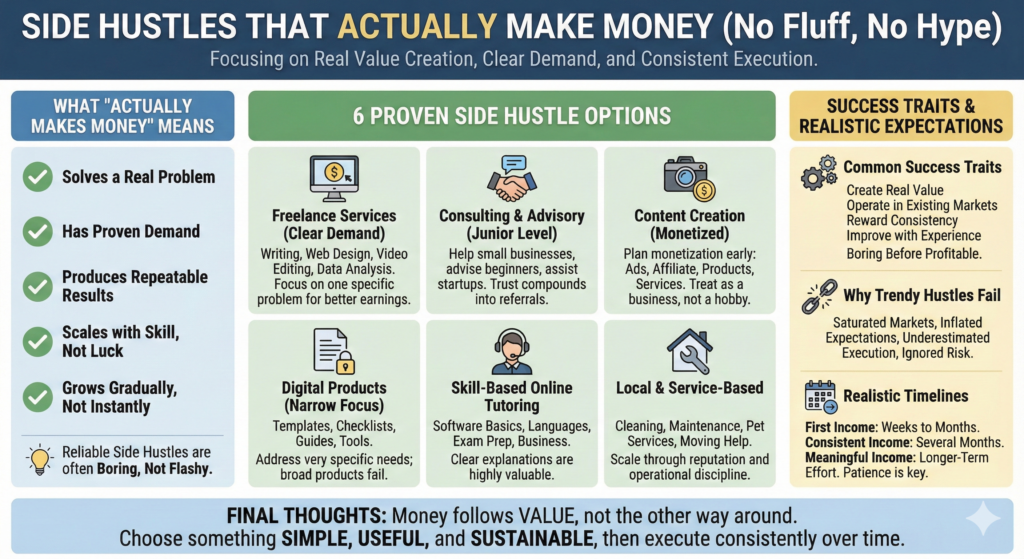
What “Actually Make Money” Really Means
Before listing examples, it’s important to define the phrase honestly.
A side hustle that “actually makes money”:
- Solves a real problem
- Has proven demand
- Produces repeatable results
- Scales with skill, not luck
- Grows gradually, not instantly
From experience, the most reliable side hustles are often boring, not flashy.
1. Freelance Services With Clear Market Demand
Freelancing remains one of the most consistent ways to generate side income.
Services that tend to perform well:
- Writing and editing
- Web design and basic development
- SEO assistance
- Video editing
- Data analysis and reporting
- Virtual assistance for businesses
Why freelancing works:
- Businesses already spend money here
- Results are measurable
- Payment is tied to delivery, not speculation
From experience, freelancers who focus on one specific problem (instead of offering everything) tend to earn more and faster.
2. Consulting and Advisory (Even at a Junior Level)
Consulting doesn’t require being the world’s top expert. It requires being useful to a specific audience.
Examples:
- Helping small businesses with basic analytics
- Advising beginners on tools or processes
- Assisting startups with research or documentation
- Providing operational or organizational support
This works because:
- Time is exchanged for expertise
- Trust compounds over time
- Referrals become a major growth channel
From experience, consulting often starts as a side hustle and becomes a main income once positioning improves.
3. Content Creation With Monetization Strategy
Content creation only “actually makes money” when monetization is planned early.
Common monetization paths:
- Ads (display networks)
- Affiliate partnerships
- Digital products
- Services linked to content
- Sponsorships (later stage)
This side hustle:
- Takes time
- Requires consistency
- Builds long-term assets
From experience, creators who treat content like a business, not a hobby, are the ones who see real financial results.
4. Digital Products That Solve Narrow Problems
Digital products work best when they address very specific needs.
Examples:
- Templates
- Checklists
- Guides
- Small tools
- Educational resources
Why they work:
- High margins
- No inventory
- Scalable distribution
However, from experience, digital products fail when they are too broad or too generic. Narrow focus increases conversion and reduces competition.
5. Skill-Based Online Tutoring or Coaching
Teaching works when it’s practical.
Topics that perform well:
- Software basics
- Language learning
- Exam preparation
- Business fundamentals
- Creative skills
This side hustle:
- Generates predictable income
- Builds authority
- Requires minimal startup cost
From experience, people underestimate how valuable clear explanations are — even for simple topics.
6. Local and Service-Based Businesses
Local side hustles consistently make money because demand is constant.
Examples:
- Cleaning services
- Maintenance and repairs
- Pet services
- Moving help
- Event setup or breakdown
These hustles:
- Don’t depend on algorithms
- Scale through reputation
- Require operational discipline more than technical skill
From experience, local services are among the most underestimated but reliable income sources.
What These Side Hustles Have in Common
Despite their differences, successful side hustles share common traits:
- They create real value
- They operate in existing markets
- They reward consistency
- They improve with experience
- They are boring before they are profitable
Side hustles that promise excitement first and value later rarely work.
Why Most “Trendy” Side Hustles Fail
Trendy side hustles often fail because:
- Markets are already saturated
- Expectations are inflated
- Execution is underestimated
- Risk is ignored
From experience, the faster an opportunity spreads online, the harder it is to extract meaningful value from it.
You can see the most common mistakes in the side hustles in this article: Common Mistakes on Side Hustles
How Long Does It Take to Make Money?
There is no universal timeline.
However, realistic expectations look like:
- First income: weeks to months
- Consistent income: several months
- Meaningful income: longer-term effort
Side hustles are not shortcuts — they are parallel paths that reward patience.
How to Choose the Right One for You
Instead of asking “Which side hustle makes the most money?”, ask:
- What problem can I solve reliably?
- What skills can I improve?
- How much time can I commit?
- What risk level can I handle?
From experience, alignment beats optimization early on.
The Role of Systems and Process
Side hustles that actually make money rely on:
- Repeatable processes
- Clear pricing
- Time boundaries
- Continuous improvement
Income grows when chaos is reduced.
Final Thoughts
Side hustles that actually make money are not secrets. They are not hidden tricks or loopholes.
They work because:
- Demand already exists
- Value is clearly delivered
- Effort compounds over time
If a side hustle sounds too easy, too fast, or too good to be true — it usually is.
The real advantage comes from choosing something simple, useful, and sustainable, then executing consistently.
Money follows value. Not the other way around.