
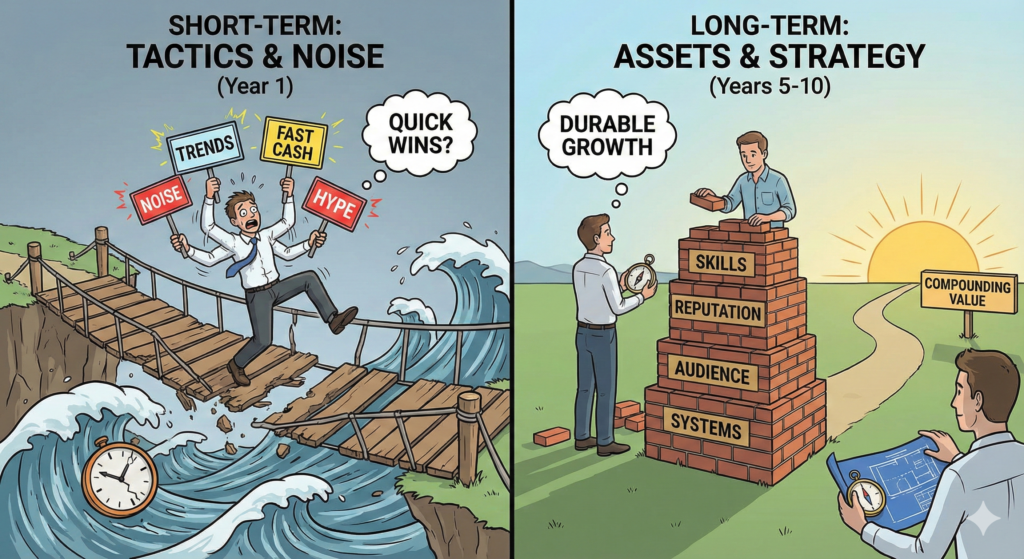
Most side hustle advice is short-term by design. It focuses on quick wins, fast validation, and immediate income. While this approach can be useful at the beginning, it becomes limiting — and often destructive — once you start building something meaningful.
The side hustles that truly change people’s lives are rarely the fastest ones. They are the ones designed with long-term leverage in mind.
This article explores how to think about side hustles with a 5–10 year horizon, and why this mindset dramatically improves decision-making, sustainability, and outcomes.
Why Short-Term Thinking Breaks Side Hustles
Short-term thinking creates predictable problems:
- Constant strategy switching
- Chasing trends instead of building assets
- Overreacting to temporary setbacks
- Prioritizing speed over durability
In the short term, these behaviors can feel productive. In the long term, they prevent compounding.
From experience, most stalled side hustles don’t fail because of bad ideas — they fail because they were optimized for immediate results, not long-term value.
What Changes When You Think in 5–10 Years
A long-term horizon changes the questions you ask.
Instead of:
- “How fast can this make money?”
You ask: - “Will this still make sense in five years?”
Instead of:
- “What’s working right now?”
You ask: - “What skills and systems compound over time?”
This shift immediately filters out many fragile opportunities and highlights those worth building.
Side Hustles as Assets, Not Tactics
Short-term thinking treats side hustles as tactics.
Long-term thinking treats them as assets.
Assets have three defining traits:
- They retain value over time
- They can be improved incrementally
- They benefit from compounding effects
Examples of side hustle assets include:
- Skill-based reputations
- Audiences and distribution
- Intellectual property
- Systems and processes
- Capital with disciplined deployment
From experience, side hustles that become assets are far more resilient than those dependent on constant novelty.
Skill Compounding Is the Real Flywheel
One of the most underestimated advantages of long-term thinking is skill compounding.
Skills don’t reset. They stack.
When you invest in side hustles that build:
- Analytical thinking
- Communication
- Risk management
- Systems design
- Market understanding
…you carry those skills into every future project.
From experience, the side hustle itself may change — but the skill base remains, making each new effort more efficient than the last.
Time Is Not the Only Long-Term Variable
People often think long-term strategy is only about patience. It’s not.
Long-term side hustle strategy balances:
- Time
- Energy
- Capital
- Attention
- Risk exposure
Burning out in year two eliminates year five entirely.
From experience, longevity is the ultimate competitive advantage. Many opportunities are won simply by staying in the game longer than others.
Designing for Durability Over Optimization
Short-term thinking optimizes for peak performance.
Long-term thinking optimizes for survivability.
Questions that matter long-term:
- Can this operate during bad periods?
- Does it break under stress?
- How fragile is the income stream?
- What happens if conditions change?
In finance and crypto side hustles especially, durability matters more than maximum returns. Volatility is inevitable. Fragile systems don’t survive it.
Optionality Beats Prediction
Trying to predict the future is fragile.
Building optionality is robust.
Long-term side hustles benefit from:
- Multiple revenue paths
- Transferable skills
- Reversible decisions
- Low irreversible commitments
From experience, the most successful side hustlers don’t predict perfectly — they position themselves to adapt.
Optionality keeps you flexible when the environment changes.
The Role of Capital in Long-Term Strategy
Capital compounds only if it survives.
Long-term thinking shifts focus from:
- Maximizing short-term returns
to: - Preserving capital and increasing opportunity access
This is especially relevant in financial and crypto side hustles, where aggressive strategies can eliminate future participation.
From experience, conservative position sizing early creates freedom later. You can always increase exposure. You can’t undo catastrophic loss.
Reputation Is a Hidden Long-Term Asset
Reputation compounds silently.
Whether your side hustle involves:
- Clients
- Audiences
- Communities
- Partnerships
Trust becomes leverage over time.
Short-term gains that damage credibility are expensive in the long run. Long-term thinkers protect reputation even when it costs money or speed.
From experience, opportunities often arrive years later because of decisions made quietly and consistently early on.
Thinking in Phases, Not Forever
Long-term strategy does not mean rigidity.
A 5–10 year horizon is best approached in phases:
- Learning phase
- Validation phase
- Optimization phase
- Scaling phase
- Consolidation or transition phase
Each phase has different priorities.
Mistakes happen when people apply the wrong phase logic — for example, trying to scale before validating, or optimizing before stabilizing.
Side Hustles and Life Evolution
Your life will change over 5–10 years.
- Responsibilities increase
- Priorities shift
- Risk tolerance evolves
A long-term side hustle strategy accounts for this.
From experience, the best side hustles:
- Can be scaled down
- Can be paused
- Can evolve with life circumstances
Rigid models often collapse under life pressure.
Measuring Progress Long-Term
Long-term success metrics look different.
Instead of asking:
- “How much did I make this month?”
You ask:
- “Is this easier than last year?”
- “Am I more skilled than before?”
- “Is decision quality improving?”
- “Is stress decreasing as competence grows?”
These indicators predict sustainability better than short-term revenue spikes.
Why Most People Never Reach the Long Term
Ironically, most people fail to benefit from long-term thinking because they quit before it matters.
Common reasons:
- Impatience
- Comparison with others
- Overexposure to noise
- Unrealistic timelines
From experience, those who win long-term are rarely the most aggressive — they are the most consistent and deliberate.
A Simple Long-Term Filter
Before committing to a side hustle, ask:
- Will this build skills I want in 5 years?
- Does this create an asset or just cash flow?
- Can this survive bad periods?
- Does this align with who I want to become?
- Would I still do this if results were slow?
If most answers are yes, you’re likely thinking long-term.
Final Thoughts
Side hustles are not just income experiments. They are career-shaping decisions, even when they start small.
Thinking in 5–10 year horizons doesn’t mean moving slowly. It means moving intentionally.
The biggest advantage you can give yourself is not speed, leverage, or insider knowledge — it’s patience combined with strategy.
Trends fade. Markets change. Tools evolve.
Skills compound. Assets grow. Reputation endures.
And side hustles built with long-term thinking don’t just survive — they become unfair advantages over time.
It’s possible to have several long-term side hustles and others in the short term, thus carrying out multiple side hustles. If this is your idea or you’re interested, you could read this article which explains very well how to do it: Multiples Side Hustles.