
At some point, success creates a new problem.
Once your first side hustle starts working — or once you’ve built enough skills and confidence — opportunities multiply. New ideas appear. New income streams become tempting. Suddenly, the question is no longer “How do I start a side hustle?” but:
“How many side hustles should I run at the same time?”
This is where many people go wrong.
Building multiple side hustles can increase optionality and resilience — or it can completely destroy focus, execution quality, and results. The difference lies in structure, sequencing, and intention.
Why People Want Multiple Side Hustles
The desire for multiple side hustles is understandable.
Common motivations include:
- Diversifying income
- Reducing dependence on a single stream
- Exploring new interests
- Fear of missing out on opportunities
- Boredom once the first system stabilizes
From experience, the reason you want multiple side hustles matters more than the number itself.
Diversification driven by strategy is very different from diversification driven by distraction.
The Core Risk: Fragmentation
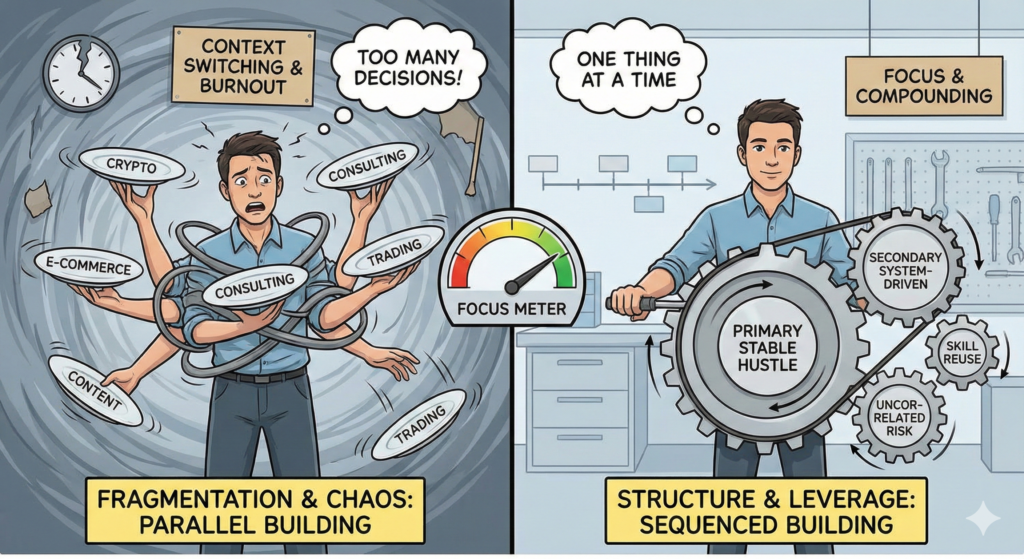
The biggest danger of multiple side hustles is not failure — it’s mediocrity across all of them.
Fragmentation shows up as:
- Shallow progress everywhere
- Constant context switching
- Inconsistent execution
- Decision fatigue
- Loss of momentum
Most side hustles need focused attention to reach escape velocity. Splitting attention too early prevents any of them from compounding.
From experience, more hustles often mean less total output.
One Primary, One Secondary (The Sustainable Model)
A useful rule of thumb is the primary–secondary model.
- Primary side hustle:
Your main focus, where most time, energy, and decision-making go. - Secondary side hustle:
Low-maintenance, experimental, or largely system-driven.
Running two demanding side hustles at the same time is almost always a mistake.
Remember that your primary side hustle will be your first choice of side hustle as an income generation system. You can find more information about this in this article, which I recommend reading: Side Hustles as a Wealth-Building Sistem.
From experience, one hustle should grow, while the other should mostly run.
When Multiple Side Hustles Make Sense
Multiple side hustles work best under specific conditions.
They make sense if:
- At least one hustle is already stable
- Systems are documented and predictable
- Time requirements are clearly capped
- Risk is spread, not duplicated
- You are not emotionally attached to all of them equally
They usually fail if:
- All hustles are early-stage
- All require daily attention
- All depend on the same variable (time, market, platform)
- You’re chasing novelty instead of leverage
Timing matters more than ambition.
Sequence Beats Parallelism
Most people try to build side hustles in parallel.
The better approach is sequencing.
Sequence looks like this:
- Build one side hustle to stability
- Reduce its active time requirement
- Only then add another
Parallel building feels productive but usually slows everything down.
From experience, sequencing allows learning and capital to compound rather than reset.
Skill Reuse Is the Hidden Advantage
The most effective multi-hustle setups reuse skills.
Examples:
- Consulting + content + digital products
- Trading + research + education
- Analytics tools + advisory services
This creates skill leverage, not just income diversification.
Starting unrelated hustles in different domains dramatically increases cognitive load and learning time.
From experience, shared skill foundations make multiple hustles far more sustainable.
Financial and Crypto Side Hustles: Correlation Risk
In financial and crypto side hustles, running multiple hustles does not always mean diversification.
Common mistake:
- Multiple strategies that all depend on the same market conditions
When markets turn, everything fails at once.
From experience:
- True diversification means different return drivers
- Correlated risk gives false confidence
If multiple hustles rise and fall together, you don’t have multiple hustles — you have one fragile system.
Time Is Not the Only Constraint
People focus too much on time allocation.
Other critical constraints include:
- Attention
- Emotional bandwidth
- Decision quality
- Stress tolerance
Running multiple side hustles increases:
- Number of decisions
- Consequences of mistakes
- Mental load
From experience, burnout often comes from decision overload, not long hours.
Reducing decisions is as important as reducing tasks.
Clear Rules Prevent Chaos
If you run more than one side hustle, rules are mandatory.
Examples of useful rules:
- Maximum hours per hustle
- Fixed review periods
- Predefined kill criteria
- Capital allocation limits
- No new hustles until X milestone is reached
Rules turn ambition into structure.
Without rules, expansion becomes reactive — and reactive systems break.
Know When to Say No
The most underrated skill in multi-hustle building is rejection.
Saying no to:
- “Good” ideas that arrive at the wrong time
- Opportunities that don’t fit your strategy
- Hustles that compete for the same resources
From experience, saying no preserves momentum in what already works.
Focus is a competitive advantage.
If you’ve already started a side hustle that you regret for any of the reasons mentioned, you could review this article to understand how and when to quit: When to Quit or Pivot a Side Hustle
The Illusion of Safety in Numbers
Many people believe multiple side hustles automatically reduce risk.
In reality, poorly managed multiplicity often increases risk:
- Less oversight per system
- Slower response to problems
- Higher chance of missing critical signals
One well-managed hustle is safer than three neglected ones.
Safety comes from control, not quantity.
A Practical Framework
Before adding a new side hustle, ask:
- Is my current hustle stable without daily attention?
- Does the new hustle reuse existing skills?
- Does it introduce uncorrelated risk?
- Do I have clear limits for time and capital?
- Would removing this hustle improve my life?
If any answer is no, wait.
From experience, patience beats diversification pressure.
Final Thoughts
Multiple side hustles are not a badge of honor.
They are a management challenge.
When built intentionally, they create resilience, optionality, and leverage.
When built impulsively, they dilute focus and slow progress.
The goal is not to do more.
The goal is to build systems that work without demanding everything from you.
One strong side hustle beats five weak ones.
And two well-structured hustles beat constant reinvention.
Focus compounds faster than opportunity ever will.