
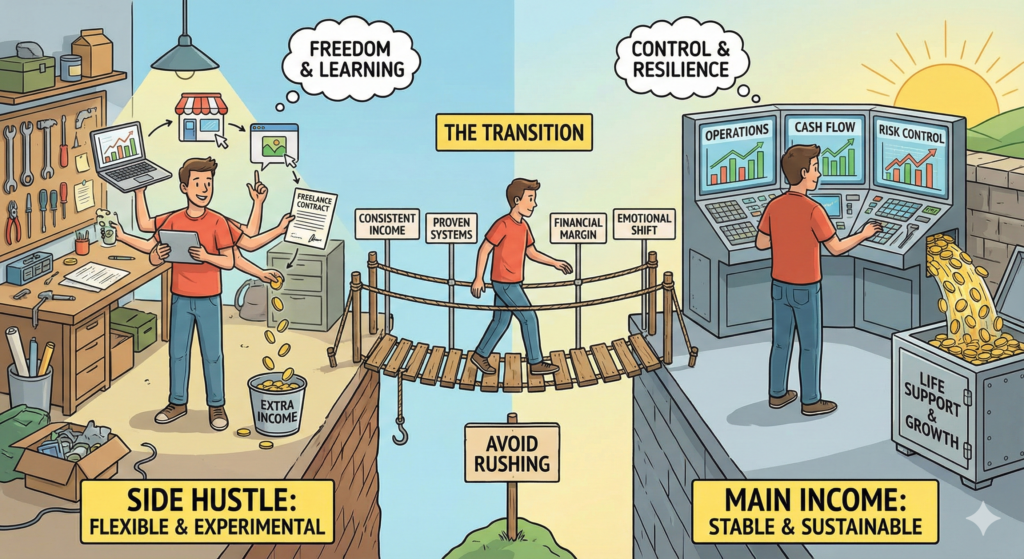
Turning a side hustle into your main source of income is one of the most appealing ideas in modern work culture. The promise is clear: more freedom, more control, and income built on your own terms.
But this transition is also where many people make their most expensive mistakes.
Quitting too early creates unnecessary risk. Waiting too long creates stagnation. The difference between a successful transition and a stressful one lies in timing, structure, and realism.
This article explains how to know when you’re ready — and how to make the transition without breaking what you’ve built.
Why This Transition Is Harder Than It Looks
A side hustle and a main income operate under very different constraints.
As a side hustle:
- Income can be inconsistent
- Risk can be tolerated
- Growth can be experimental
As a main income:
- Stability matters
- Cash flow becomes critical
- Emotional pressure increases
- Mistakes are more costly
From experience, many people underestimate how much psychology changes once a side hustle becomes the primary source of income.
What felt exciting before can quickly feel stressful when rent depends on it.
First Question: Why Do You Want to Make the Switch?
Before looking at numbers, clarify motivation.
Common reasons include:
- Escaping a job you dislike
- Desire for flexibility
- Feeling “ready” after early success
- External validation or pressure
Only some of these are good reasons.
The most reliable motivation is strategic advantage — when your side hustle clearly offers better long-term prospects than your current main income.
Running from something is rarely as effective as running toward something.
The Three Signals That You’re Getting Close
There is no single metric that guarantees readiness, but certain signals tend to appear together.
1. Income Consistency, Not Just Peaks
Occasional high months are not enough.
Before transitioning, ask:
- Has income been consistent for several months?
- Can you reasonably forecast next month’s revenue?
- Do results depend on luck or repeatable systems?
From experience, consistency matters more than maximum upside. Predictable “average” months are far more valuable than sporadic wins.
2. Your Systems Work Without Constant Hero Effort
If your side hustle only works when you:
- Overwork
- Skip rest
- Constantly react
…it’s not ready to become a main income.
Main-income hustles require:
- Clear processes
- Decision rules
- Manageable workloads
If everything depends on constant urgency, scaling pressure will break it.
3. You Have Financial Margin
Margin creates optionality.
This includes:
- Cash reserves
- Low fixed expenses
- Alternative income buffers
From experience, people who transition with margin make better decisions. Those without margin operate under fear — and fear distorts judgment.
Why “Replacing Your Salary” Is a Weak Benchmark
Many people wait until their side hustle matches their salary before quitting their job. While intuitive, this benchmark is incomplete.
Salary replacement ignores:
- Benefits
- Stability
- Variability
- Taxes
- Recovery time after bad months
A better question is:
“Can this side hustle support my life, not just my paycheck?”
Main income requires resilience, not just equivalence.
Gradual Transition Beats Hard Switches
The clean “quit and go all-in” narrative is appealing — but risky.
In practice, the most successful transitions are gradual:
- Reducing hours at a job
- Negotiating flexible arrangements
- Building reserves before quitting
- Testing full-time workload temporarily
From experience, staged transitions reduce emotional pressure and improve decision quality.
Freedom gained too early often feels like stress.
Special Considerations for Financial and Crypto Side Hustles
Financial and crypto-based side hustles deserve extra caution.
Key risks include:
- Volatility-driven income swings
- Correlated losses
- Overconfidence during favorable markets
A strong run does not guarantee sustainability.
From experience, financial side hustles work best as:
- Part of a diversified income strategy
- Capital-efficient systems
- Disciplined, rules-based operations
Relying entirely on market-dependent income requires exceptional risk control — and emotional discipline.
Ask the “Bad Month” Question
Before transitioning, simulate failure.
Ask:
- What happens in a bad month?
- Can I cover expenses without panic?
- Will losses force bad decisions?
If one bad month breaks the system, it’s not ready.
Main income must survive drawdowns — not just thrive during good periods.
The Identity Shift No One Talks About
Moving from side hustle to main income changes identity.
You’re no longer:
- “Trying something on the side”
- Experimenting casually
- Learning without pressure
You become:
- Fully accountable
- Responsible for outcomes
- Exposed to self-doubt in new ways
From experience, this identity shift is often harder than the financial transition. Preparation matters.
How to Make the Transition Intentionally
A structured approach helps reduce risk.
Key steps include:
- Defining minimum acceptable income
- Building reserves beyond comfort
- Stress-testing systems
- Setting clear review points
- Keeping optional exit paths open
Optionality is power. The ability to reverse course reduces fear and improves execution.
When Not to Make the Transition
Do not transition if:
- Income relies on a single fragile variable
- Results depend heavily on external conditions
- Stress already feels unmanageable
- You’re seeking escape rather than opportunity
From experience, forcing the transition rarely ends well. Timing matters.
Redefining Success After the Switch
Once the transition is made, success should be redefined.
Success is not:
- Maximum income
- Constant growth
- Endless hustle
Success is:
- Sustainability
- Decision clarity
- Alignment with life priorities
Main income should support life — not consume it.
Final Thoughts
Turning a side hustle into your main income is not a leap of faith. It’s a strategic transition.
When done intentionally — with consistency, margin, and systems — it can dramatically improve quality of life.
When rushed, it turns freedom into pressure.
The goal is not to quit your job as fast as possible.
The goal is to build something strong enough that quitting becomes the logical next step.
When that moment arrives, you’ll know — not because of hype or emotion, but because the numbers, systems, and reality align.