
One of the most uncomfortable topics in the side hustle world is quitting.
Most content focuses on starting, growing, and scaling — but very little addresses what to do when a side hustle isn’t working or no longer makes sense. As a result, many people stay stuck in projects that drain time, capital, and energy long after the signal is clear.
Quitting is not failure.
Neither is pivoting.
The real failure is ignoring evidence.
This article explains how to decide — rationally and without emotion — whether to continue, pivot, or walk away from a side hustle.
Why People Stay Too Long in the Wrong Side Hustle
Most people don’t quit because of logic. They stay because of psychology.
Common reasons include:
- Sunk cost fallacy (“I’ve already invested too much”)
- Identity attachment (“This is who I am now”)
- Fear of starting over
- Social pressure or public commitment
- Confusing persistence with discipline
From experience, persistence without feedback is not grit — it’s inertia.
A side hustle should earn the right to continue.
First: Separate Temporary Struggles From Structural Problems
Every side hustle goes through difficult phases. Not every slowdown is a signal to quit.
The key distinction is between:
- Execution problems, and
- Structural misalignment
Execution problems can be fixed. Structural problems usually can’t.
Signs You’re Facing an Execution Problem
You may need to improve — not quit — if:
- The model makes sense, but your skills are still developing
- Early traction exists, but consistency is lacking
- You haven’t tested long enough to gather real data
- Results improve when effort improves
In these cases, the solution is often refinement, patience, or better systems.
Signs You’re Facing a Structural Problem
More concerning signals include:
- No traction despite sustained, focused effort
- A model that depends on conditions you can’t control
- Returns that don’t justify time, stress, or risk
- A side hustle that conflicts with your lifestyle or values
- Growing resentment toward the work itself
From experience, structural problems don’t improve with more effort. They require change.
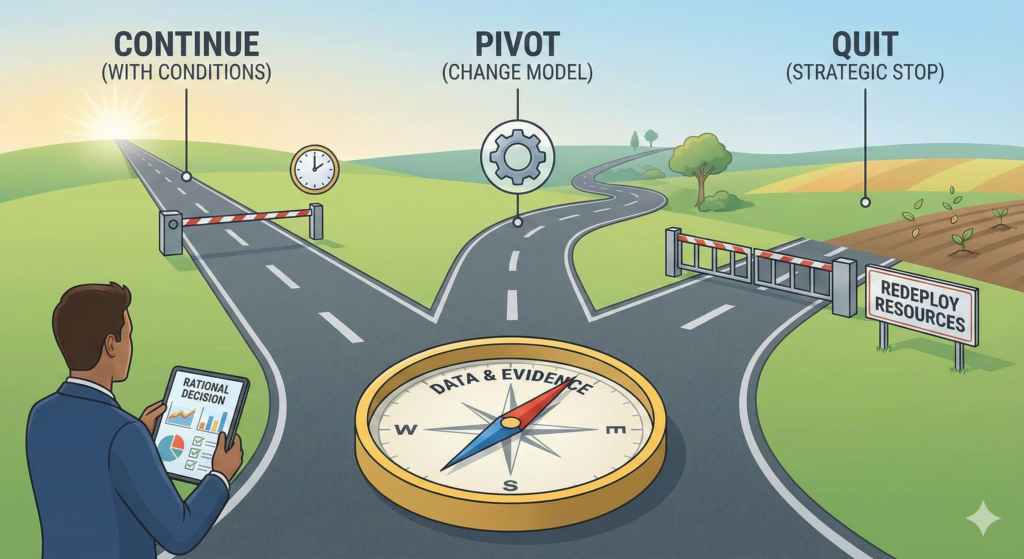
The Three Legitimate Options: Continue, Pivot, or Quit
Once you’re honest about the situation, you have three valid paths.
Option 1: Continue (But With Clear Conditions)
Continuing blindly is a mistake. Continuing intentionally is not.
You should continue if:
- The fundamentals are sound
- You see measurable progress
- The upside still justifies the effort
- You enjoy the learning process, even if results lag
However, continuation should always include conditions:
- A time-bound review period
- Clear performance metrics
- Defined changes to test
Continuing without constraints is how side hustles quietly drain years.
Option 2: Pivot (Change the Model, Not the Goal)
Pivoting means preserving what works while changing what doesn’t.
Common pivots include:
- Changing the target audience
- Adjusting pricing or positioning
- Shifting from active to semi-passive models
- Moving from capital-heavy to skill-based (or vice versa)
- Reducing scope to regain focus
From experience, pivots are most effective when:
- Core skills remain relevant
- Some traction already exists
- Feedback clearly points to a better direction
A pivot is not starting over — it’s course correction.
Option 3: Quit (Strategically, Not Emotionally)
Quitting becomes the right decision when:
- Opportunity cost exceeds potential upside
- Stress consistently outweighs reward
- Capital risk is no longer justified
- You would not choose this side hustle again today
Quitting frees resources — time, energy, attention — that can be redeployed elsewhere.
From experience, people rarely regret quitting too early. They often regret quitting too late.
How Long Is “Long Enough” to Decide?
There is no universal timeline, but there are guidelines.
In general:
- Skill-based hustles need months of consistent effort
- Content-based hustles often need 6–12 months
- Financial strategies need enough cycles to evaluate risk-adjusted returns
What matters is not time alone, but quality of experimentation.
If effort has been inconsistent, data is unreliable.
A Simple Decision Framework
Before deciding, answer these questions honestly:
- If I were starting today, would I choose this side hustle again?
- Has my understanding improved meaningfully over time?
- Are results improving — even slowly?
- Is the stress proportional to the upside?
- What am I giving up by continuing?
If most answers point toward misalignment, the decision is already made.
Emotional Discipline Matters More Than Motivation
Quitting often feels like admitting defeat — but that framing is wrong.
Side hustles are experiments.
Experiments are meant to end.
From experience, emotional discipline means:
- Detaching ego from outcomes
- Viewing decisions as capital allocation
- Accepting uncertainty without self-judgment
Staying in a bad trade doesn’t make you disciplined.
Exiting it does.
Financial and Crypto Side Hustles: A Special Case
In financial and crypto side hustles, quitting or reducing exposure is often framed as “missing out.”
This mindset is dangerous.
Markets offer endless opportunities. Capital preservation is what allows participation over the long term.
From experience:
- Cutting exposure is often a sign of maturity
- Reducing size is often smarter than all-or-nothing decisions
- Survival beats being right
You can always re-enter — if you still have capital.
Reframing Quitting as Strategic Progress
Every side hustle you quit teaches you:
- What you don’t enjoy
- What doesn’t fit your life
- What risk feels like in practice
- What kind of work energizes you
This information compounds.
Many successful side hustles are built on lessons from projects that didn’t last.
Quitting is not wasted time — it’s data collection.
Final Thoughts
The goal of a side hustle is not persistence at all costs. It’s progress toward a better outcome.
Continuing, pivoting, and quitting are all valid moves — when chosen deliberately.
The real mistake is staying stuck because of fear, ego, or inertia.
When decisions are based on evidence instead of emotion, even quitting becomes a form of forward motion.
And often, it’s the move that makes the next side hustle succeed.
If you ultimately decide not to abandon the side hustle you’ve already started, you need to take a look at the following article: From Side Hustle to Main Income