
The freelance economy is built on a flaw. We trade our time for money, a linear exchange that caps our income at the number of hours we can stay awake. When we stop working, the invoices stop coming. Worse, the “hourly rate” mentality invites clients to micromanage our time rather than valuing our results.
The solution to this trap is the Productized Service.
A productized service takes a specific, high-value skill you already possess and packages it like a product on a shelf. It has a fixed scope, a fixed price, and a fixed timeline. It eliminates the dreaded “scope creep” of consulting and replaces custom proposals with a simple “Buy Now” button.
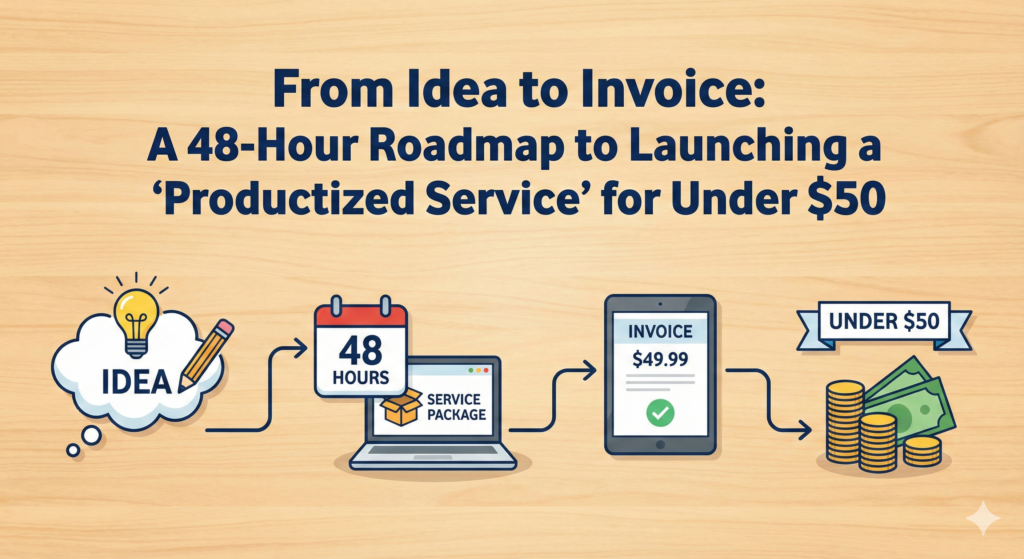
Best of all, you do not need a venture capital injection or months of development to launch one. You need a weekend and less than $50. Here is your 48-hour roadmap to building a scalable, automated service business on a shoestring budget.
The Psychology of the Pivot (Hours 0–4)
The first step is mental, not technical. You must stop viewing yourself as a “helper” who does whatever the client asks, and start viewing yourself as a “surgeon” who performs one specific operation perfectly.
Generalists struggle; specialists thrive. A general “graphic designer” competes in a race to the bottom on price. A specialist who sells “High-Converting YouTube Thumbnails for FinTech Channels” commands a premium because they solve a specific, expensive problem.
Spend your first four hours defining your “One Problem, One Solution” offer. It must be a task you can perform repeatedly with high quality and minimal variation. Good examples include a “24-Hour Website UX Audit,” a “Three-Email Welcome Sequence for E-commerce,” or “Podcast Audio Mastering.” If you can’t write the scope of work on the back of a napkin, it is too complex. Simplify it until it fits in a box.
The Digital Storefront (Hours 4–12)
Once your offer is defined, you need a place to sell it. In the past, this meant hiring a developer or wrestling with WordPress. Today, you can build a professional, high-converting landing page for the cost of a few coffees.
Your tool of choice here is Carrd or Notion. For under $20 a year, a Carrd “Pro” subscription allows you to connect a custom domain and build a sleek, one-page site that looks like it cost thousands. If you want to spend zero dollars, a public Notion page acts as a perfectly acceptable, minimalist landing page that signals “efficiency” rather than “flash.”
Your landing page needs only three sections. First, the Headline, which states the specific problem you solve (e.g., “I fix broken checkout flows for Shopify stores”). Second, the Deliverables, a bulleted list of exactly what the client gets (e.g., “A 10-minute video audit and a PDF checklist of fixes”). Third, the Call to Action, a button that allows them to pay you immediately. Do not include a “Contact Us” form. The goal is to avoid the friction of discovery calls and move straight to the transaction.
The Transaction Engine (Hours 12–24)
The hallmark of a productized service is upfront payment. You are selling a product, not a promise. To facilitate this, you need a friction-free payment and intake system.
Stripe is the industry standard for a reason. It is free to set up and charges only a small transaction fee per sale. Create a “Payment Link” in your Stripe dashboard. This is a URL you can embed directly into your Carrd or Notion site. When a client clicks “Buy Now,” they are taken to a secure checkout page.
Crucially, you must automate what happens after they pay. This is where the “service” feels like a “product.” Configure Stripe to redirect the customer to a Trello board or a Google Form upon successful payment. This intake form collects everything you need to start the job—login credentials, brand assets, or document links.
By the end of the first 24 hours, you have a functioning business. You have a domain (approx. $12), a hosting platform ($0–$19), and a payment processor ($0 upfront). You are ready to accept money.
The “Permissionless” Launch (Hours 24–48)
The final day is dedicated to acquisition. Do not waste money on Facebook ads or Google clicks; your budget is $50, and paid traffic requires optimization time you don’t have. Instead, use a “Permissionless Apprentice” strategy.
Identify ten ideal clients who clearly have the problem you solve. If you sell “Twitter Bio Optimizations,” find ten founders with terrible bios. If you sell “Podcast Audio Polishing,” find ten podcasters with bad audio quality.
Do the work for them before they hire you. Create a sample. Audit their site. Rewrite their bio. Then, send them a cold email or DM with the completed sample attached. The message is simple: “I noticed X was broken, so I fixed it for you. Here is the result. If you want me to do this for your whole backlog, you can purchase my package here.”
This approach bypasses the need for “trust building” because you have already proven your competence. It is aggressive, high-value, and costs nothing but your time. Even a 10% conversion rate on twenty messages secures your first paying client and validates your business model.
The Efficiency Dividend
By the end of 48 hours, you have not just built a “side hustle”; you have constructed an asset. You have decoupled your income from your presence. A productized service allows you to batch your work, automate your administration, and eventually hire others to execute the “assembly line” you have built.
You have moved from being an employee of the gig economy to an owner of a digital factory. And you did it for less than the cost of a dinner for two.