
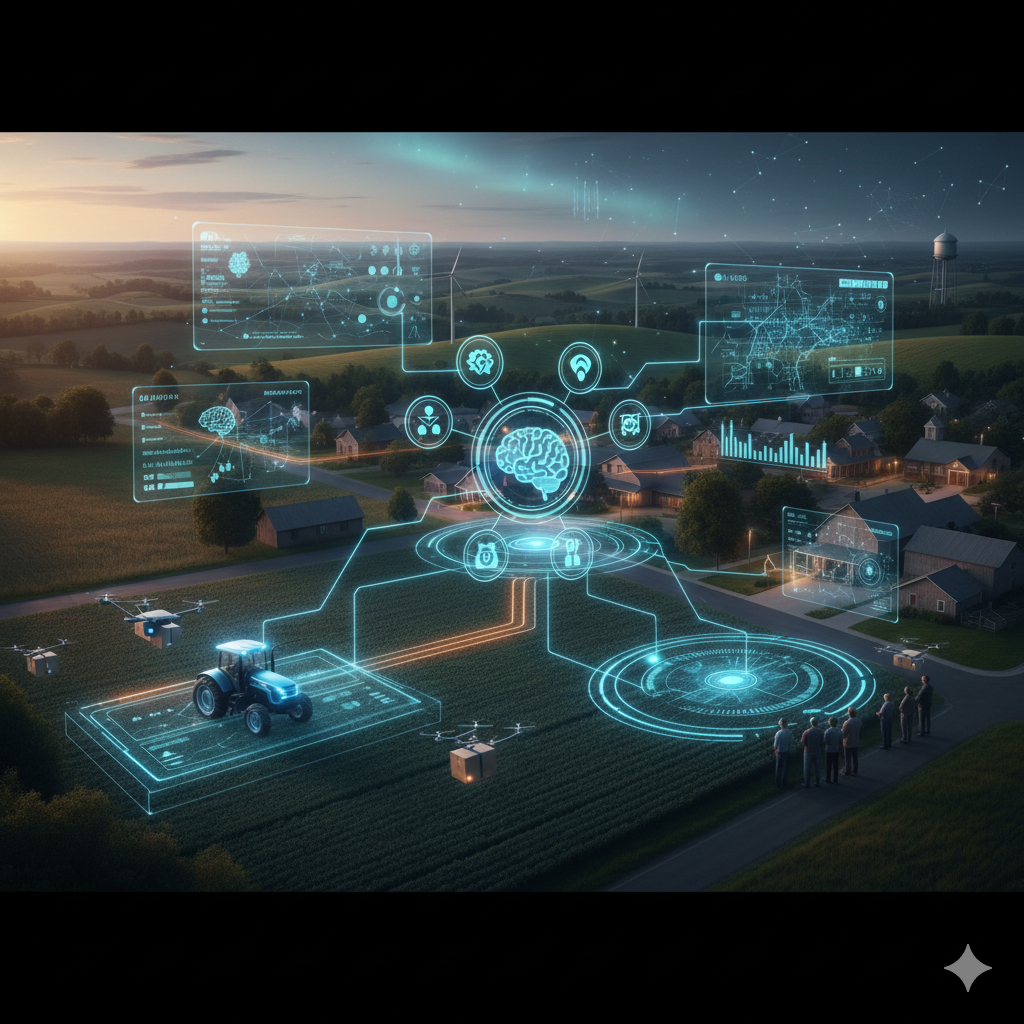
For generations, the economic narrative of rural America has been one of trade-offs. You accepted lower wages and limited career mobility in exchange for open space, community, and a lower cost of living. To earn a “city salary,” you had to leave.
This calculation is no longer valid. The widespread deployment of fiber optics and Low Earth Orbit (LEO) satellite internet, such as Starlink, has shattered the geographic monopoly on high-value work. The digital economy does not care about your zip code; it cares about your competency. In fact, the very traits that define rural life—resourcefulness, technical self-reliance, and deep operational knowledge—are scarce commodities in the digital marketplace.
The most profitable path for the rural resident in 2026 is not to look for a remote job that tolerates your location, but to build a business that capitalizes on your unique, “boots-on-the-ground” expertise. We are moving from an era of extracting resources to extracting knowledge. Here is how to turn your practical experience into a premium digital export.
The Knowledge Harvest: AgriTech and Technical Communication
Agriculture has quietly become one of the most technologically advanced sectors on the planet. The modern tractor is a data center on wheels; yield mapping involves complex geospatial analysis; and irrigation systems are essentially IoT (Internet of Things) networks. Yet, there is a massive talent gap. The engineers in Silicon Valley who build these systems rarely understand the mud-and-grease reality of implementing them.
This creates a lucrative opening for AgriTech Implementation Consulting. If you have spent years troubleshooting a John Deere Operations Center or configuring Precision Planting systems, you possess a specialized skill set that commands $100 to $150 an hour. You can offer remote diagnostics and implementation planning to other farms or act as a bridge between the tech startups and the growers. You are selling “translation” services—translating complex software into practical field operations.
Similarly, the industrial sector is desperate for Specialized Technical Writers. Marketing agencies in New York do not know the difference between a combine harvester and a swather, yet they are hired to write user manuals and white papers for heavy equipment manufacturers. A writer with genuine industry context—someone who understands hydraulics, logistics, or agronomy—can charge between $0.50 and $1.00 per word. By positioning yourself as a Subject Matter Expert (SME) who writes, rather than just a copywriter, you bypass the “race to the bottom” of general freelance writing.
Digital Main Street: Protecting and promoting the Local Economy
Small-town businesses—the local grain co-op, the independent bank, the family-owned hardware store—are facing the same digital threats as Fortune 500 companies, but they lack the budget for a Chief Information Security Officer. They are increasingly targeted by ransomware attacks because they are seen as “soft targets.”
This creates a demand for Rural Cybersecurity Consulting. You do not need to be an elite hacker to provide value here. Most small businesses fail on the basics: they lack off-site cloud backups, they use weak passwords, and their Wi-Fi is unsecured. A service that provides a “Digital Health Check”—setting up automated backups, configuring firewalls, and training staff on phishing awareness—can be sold on a monthly retainer. You are selling insurance against catastrophe. The trust you already have in the community is your greatest marketing asset; a local business owner will trust a neighbor with their passwords far sooner than they will trust a faceless IT firm from the city.
On the offensive side, these same businesses often suffer from digital invisibility. They rely on word-of-mouth, which is powerful but limited. A Hyper-Local Marketing Consultant can transform a business’s revenue by simply managing their Google Business Profile. Ensuring accurate hours, responding to reviews, and uploading photos of current inventory drives actual foot traffic. Unlike a generic SEO agency that promises “rankings,” you promise “customers.” Because you can physically visit the shop to take high-quality photos and discuss strategy, your service has a tangible value that remote agencies cannot match.
The Remote Operations Center: Practical Mentorship
Finally, we must recognize that “rural skills” are in high demand globally. The practical discipline required to run a farm or manage a trade business translates perfectly to the role of a Virtual Financial Assistant. Bookkeeping for a small business requires less about “high finance” and more about ruthless organization and consistency—traits honed by the daily demands of rural life. By specializing in cloud accounting platforms like QuickBooks Online or Xero, you can manage the books for urban entrepreneurs who lack your discipline. This work is asynchronous and high-value; a clean set of books is worth thousands of dollars during tax season.
Furthermore, the “Trades Gap” has created a hunger for practical education. If you are a master welder, a heavy equipment operator, or a master carpenter, your brain is a library. Technical Mentorship is no longer limited to the shop floor. Through video conferencing, you can tutor apprentices on blueprint reading, project estimation, or trade theory. You can create digital study guides for certification exams. We are seeing a boom in the “Blue Collar Digital” economy, where veteran tradespeople monetize their experience without lifting a hammer.
The Geographic Advantage
The premise of the “Farm-to-Freelance” movement is simple: your location is a feature, not a bug. Your low overhead allows you to be price-competitive, while your specialized, practical knowledge allows you to be value-dominant.
By leveraging high-speed internet to export your expertise, you are effectively opting out of the local wage ceiling. You are bringing outside capital into your community, strengthening the local economy while securing your own financial future. The farm of the future produces data and decisions just as much as it produces crops.