
Starting a side hustle is hard.
Scaling it is harder.
Many side hustles don’t fail at the beginning — they fail right after they start working. Income increases, opportunities multiply, and suddenly what was meant to create freedom becomes another source of stress.
Burnout is not a personal weakness. It’s usually the result of poor scaling decisions.
This article explains how to scale a side hustle sustainably — without destroying your time, focus, or mental health.
Why Scaling Is Where Most Side Hustles Break
At the early stage, side hustles are simple:
- Few clients or strategies
- Clear decisions
- Limited exposure
When growth begins, complexity creeps in:
- More demands on your time
- More decisions
- More risk
- Higher expectations
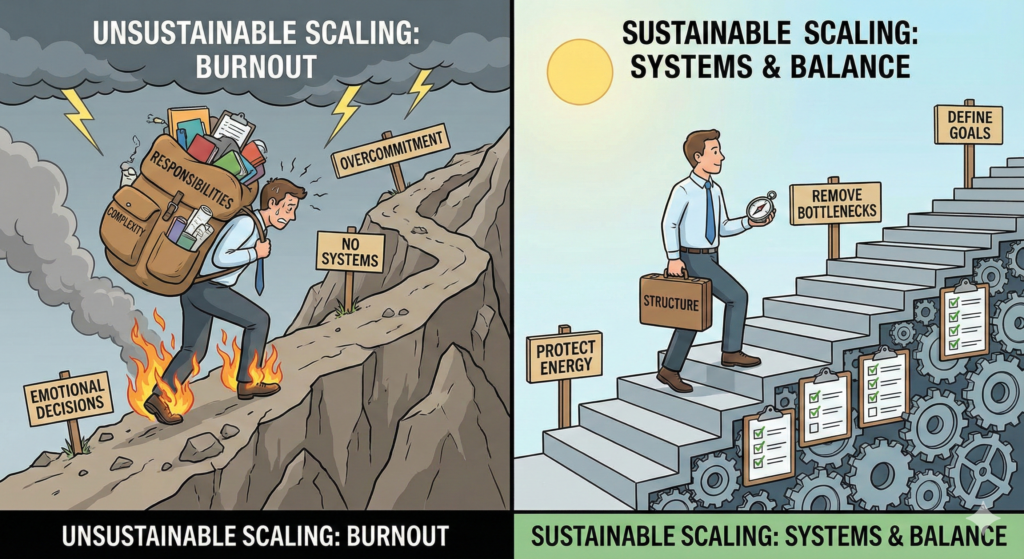
From experience, burnout usually happens when growth outpaces structure. Income increases faster than systems, boundaries, or decision-making frameworks.
Scaling without preparation turns success into pressure.
Step 1: Define What “Scaling” Actually Means to You
Scaling doesn’t mean the same thing for everyone.
For some, scaling means:
- More income
- More capital deployed
- Higher upside
For others, it means:
- Fewer hours
- More predictability
- Reduced stress
Before you scale anything, clarify your objective.
Ask yourself:
- Do I want more money or more time?
- Is this a short-term or long-term project?
- What does “enough” look like?
From experience, undefined goals lead to accidental overcommitment — one of the fastest paths to burnout.
Step 2: Stabilize Before You Expand
Scaling an unstable side hustle amplifies its problems.
Before growing, make sure:
- Income is consistent
- Results are repeatable
- You understand why it works
In financial and crypto side hustles, this means:
- Defined rules
- Documented processes
- Clear risk limits
In skill-based hustles, this means:
- Reliable delivery
- Clear scope boundaries
- Predictable workload
If results feel random, scaling will only increase volatility.
Step 3: Remove Time Bottlenecks First
Burnout is almost always time-related.
Identify:
- Tasks only you can do
- Tasks that drain energy but add little value
- Repetitive work that can be simplified
Common scaling mistakes include:
- Saying yes to everything
- Increasing volume without changing process
- Confusing growth with busyness
From experience, scaling starts by doing less, not more.
Simplification creates capacity.
Step 4: Build Systems, Not Just Momentum
Momentum feels good — systems keep things alive.
Systems can be:
- Checklists
- Standard operating procedures
- Automation
- Decision rules
In financial side hustles, systems often mean:
- Fixed position sizing
- Entry/exit criteria
- Capital allocation rules
In traditional hustles, they often mean:
- Templates
- Onboarding processes
- Clear communication frameworks
Systems reduce cognitive load. Less decision fatigue means better decisions under pressure.
Step 5: Scale One Variable at a Time
One of the most common burnout triggers is simultaneous scaling.
People try to:
- Increase income
- Add new services
- Expand platforms
- Experiment with new strategies
All at once.
This multiplies complexity and stress.
Instead:
- Scale volume or price — not both
- Add capital or complexity — not both
- Expand reach or refine execution — not both
From experience, controlled scaling beats explosive growth almost every time.
Step 6: Protect Your Energy, Not Just Your Time
Time management is overrated.
Energy management is not.
Side hustles often fail because:
- Mental fatigue accumulates
- Decision quality declines
- Motivation erodes
Signs you’re scaling too aggressively:
- Constant urgency
- Reduced patience
- Emotional reactivity
- Loss of perspective
High-quality decisions require margin.
Scaling without recovery is unsustainable.
Step 7: Reinforce Risk Management as You Grow
Growth increases exposure.
In finance and crypto side hustles especially:
- Larger positions amplify mistakes
- Small errors have bigger consequences
- Emotional stakes rise
Risk rules that worked at small scale may fail at larger size.
From experience, risk management should become stricter, not looser, as you scale.
Survival remains the first priority.
Step 8: Create Clear Stop Rules
Burnout often comes from the inability to stop.
Define in advance:
- Maximum weekly time commitment
- Maximum capital exposure
- Conditions for scaling down
Without stop rules, side hustles expand until something breaks — usually you.
Constraints are not limitations. They are safeguards.
Step 9: Periodically Reassess Alignment
What worked at one stage may not fit the next.
As your side hustle grows, ask:
- Is this still aligned with my life?
- Is the stress justified by the reward?
- Would I start this again today?
From experience, people burn out not because the side hustle is bad — but because they outgrow it and refuse to adapt.
Evolution is part of scaling.
Step 10: Remember Why You Started
Most people start side hustles to gain:
- Flexibility
- Control
- Optionality
When scaling removes those benefits, something is wrong.
Growth that costs freedom defeats the purpose.
The goal is not to build the biggest side hustle possible — it’s to build one that improves your life, not consumes it.
Final Thoughts
Scaling a side hustle is not about pushing harder. It’s about building leverage intentionally.
Sustainable growth comes from:
- Clear goals
- Strong systems
- Controlled risk
- Respect for personal limits
Burnout is not a badge of honor. It’s a signal that structure hasn’t caught up with ambition.
Scale slowly, deliberately, and with margin — and your side hustle can grow without costing you what matters most.