
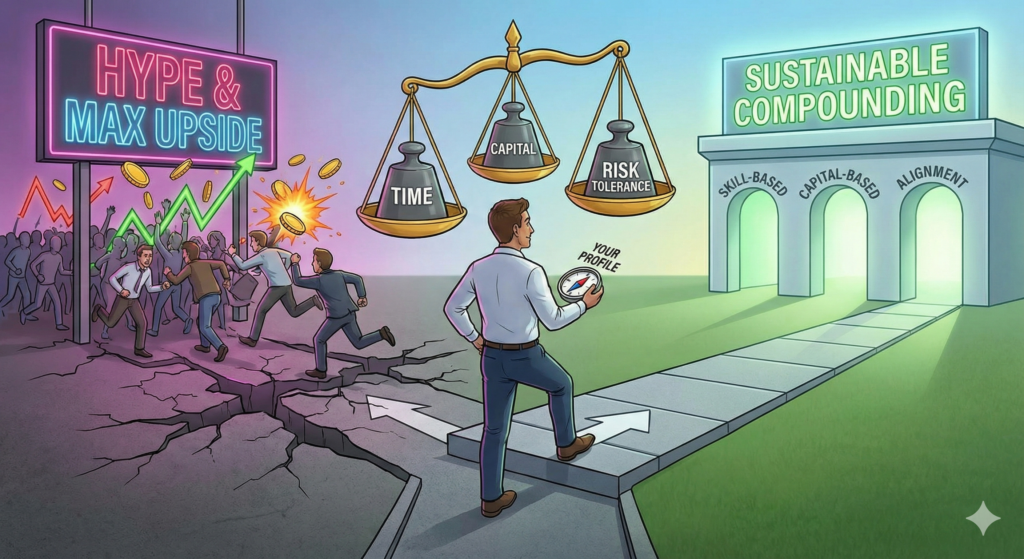
After understanding what a side hustle really is, how they differ by time, capital, and risk, and how traditional and crypto-based hustles compare, the most important question remains:
Which side hustle is right for you?
There is no universal best side hustle. What works exceptionally well for one person can be a complete failure for another. The difference is rarely intelligence or motivation — it’s alignment.
Choosing the right side hustle is less about chasing opportunity and more about matching the hustle to your personal profile.
Why Most People Choose the Wrong Side Hustle
Most people start with the wrong question:
“Which side hustle makes the most money?”
This framing almost guarantees disappointment.
High-return opportunities often come with:
- High volatility
- Emotional pressure
- Steep learning curves
- Capital risk
When those realities collide with a misaligned personal profile, the result is predictable: stress, poor decisions, and eventual abandonment.
From experience, sustainable side hustles are not chosen based on upside alone, but on fit.
The Three Core Variables You Must Assess
Every side hustle decision should start with an honest evaluation of three variables:
- Time
- Capital
- Risk tolerance
Ignoring any one of them leads to imbalance.
1. Assess Your Available Time (Realistically)
Time is often overestimated.
Ask yourself:
- How many hours per week can I commit consistently?
- Is this time mentally focused or fragmented?
- Can I maintain this schedule for 6–12 months?
A side hustle that requires daily attention will fail if your availability is sporadic. Likewise, a low-time hustle may frustrate someone who wants to stay actively involved.
In my experience, consistency beats intensity. A modest time commitment applied steadily outperforms bursts of effort followed by burnout.
2. Evaluate Your Capital — and Your Ability to Lose It
Capital-based side hustles introduce a different kind of pressure.
Important questions:
- Can I afford to lose this capital without lifestyle impact?
- Will short-term losses affect my decision-making?
- Am I prepared for drawdowns?
In finance and crypto especially, the emotional cost of losing money often exceeds the financial cost. If capital loss changes your behavior, your position size is too large.
A well-chosen side hustle should keep you psychologically stable, not constantly reactive.
3. Understand Your Risk Tolerance (Not Your Aspirations)
Many people confuse risk tolerance with risk aspiration.
Wanting high returns does not mean you can tolerate:
- Volatility
- Uncertainty
- Extended periods without results
Risk tolerance is revealed through behavior, not intention. If uncertainty causes anxiety or impulsive decisions, lower-risk hustles will likely produce better long-term outcomes.
There is no shame in preferring stability. In fact, many successful side hustles are built precisely because they are boring and predictable.
Skill-Based vs. Capital-Based Alignment
Once time, capital, and risk are clear, the next decision becomes easier.
Skill-Based Side Hustles Fit You If:
- You enjoy problem-solving and client interaction
- You prefer predictable income
- You are comfortable trading time for money initially
- You want low financial risk
Examples include consulting, freelancing, education, and content-based businesses.
Capital-Based Side Hustles Fit You If:
- You are comfortable with uncertainty
- You enjoy systems and decision-making
- You can manage emotional swings
- You understand that losses are part of the process
Examples include trading, yield strategies, and structured financial models.
From experience, capital-based hustles reward discipline far more than intelligence.
Your Personality Matters More Than the Opportunity
Two people can run the same side hustle and get opposite results.
Key personality questions:
- Do I prefer structure or flexibility?
- Do I enjoy optimization or execution?
- Am I patient with slow progress?
- How do I react under stress?
A side hustle that constantly fights your natural tendencies will eventually drain you, no matter how profitable it looks on paper.
Alignment creates sustainability.
Start Simpler Than You Think You Should
A common mistake is starting too complex.
People jump into:
- Advanced trading
- Multi-layered automation
- High-risk strategies
…before mastering fundamentals.
In practice, starting simple allows you to:
- Learn without catastrophic loss
- Build confidence
- Develop decision-making skills
Complexity can always be added later. Recovery from early failure is much harder.
Build Optionality, Not Dependency
A side hustle should expand your options, not trap you in another obligation.
Good signs:
- You can pause or scale down if needed
- You are not dependent on a single client or platform
- You can adapt the model over time
Bad signs:
- All income depends on one variable
- Stress increases faster than income
- You feel locked in early
Optionality is a hidden form of leverage.
Reassess as Your Situation Changes
The “right” side hustle today may be wrong in two years.
As your:
- Skills grow
- Capital increases
- Risk tolerance evolves
…your ideal side hustle changes too.
From experience, the most effective people periodically reassess and adjust rather than stubbornly sticking to outdated models.
Side hustles are dynamic systems, not static decisions.
A Simple Decision Framework
Before committing, ask:
- Does this fit my current time reality?
- Can I emotionally handle the downside?
- Does this align with how I like to work?
- Can I sustain this even if results are slow?
If the answer to any of these is no, keep looking.
Final Thoughts
Choosing the right side hustle is not about finding the most exciting opportunity. It’s about finding the one you can execute consistently, manage calmly, and evolve over time.
The best side hustle is rarely the one with the highest upside — it’s the one that survives long enough to compound.
Once alignment is in place, effort becomes more effective, decisions improve, and results follow naturally.