
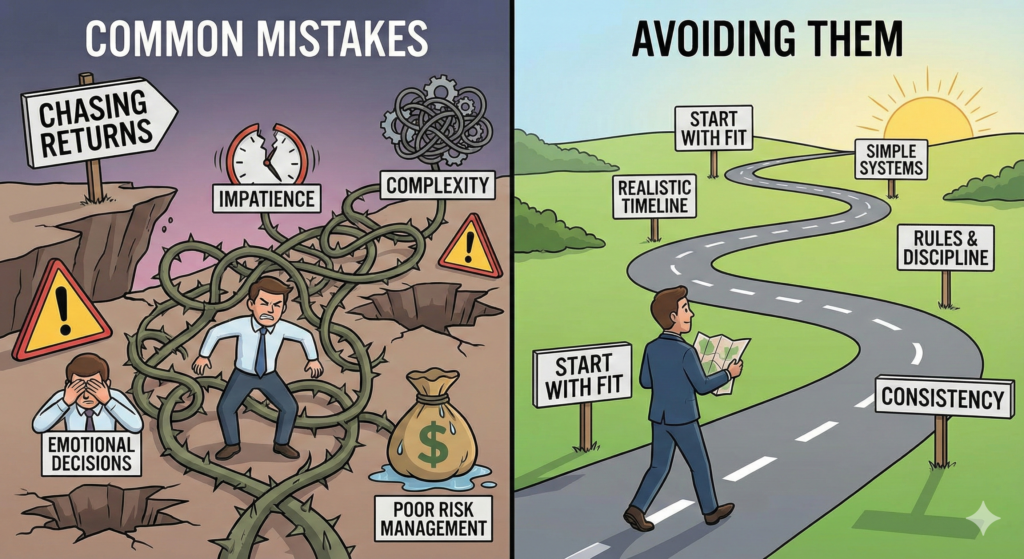
Most side hustles don’t fail because the idea was bad. They fail because of avoidable mistakes made early — often driven by unrealistic expectations, poor alignment, or lack of structure.
After working through different side hustle models, one pattern becomes clear: the same mistakes appear again and again, regardless of industry. The good news is that once you understand them, they are surprisingly easy to avoid.
This article breaks down the most common side hustle mistakes — and what to do instead.
Mistake #1: Chasing Returns Instead of Fit
One of the most damaging mistakes is choosing a side hustle based purely on potential income, not personal alignment.
High-return opportunities are seductive. Screenshots, success stories, and aggressive marketing make them hard to ignore. But returns alone say nothing about:
- Required effort
- Emotional pressure
- Learning curve
- Downside risk
From experience, a “great” side hustle that doesn’t fit your time, personality, or risk tolerance will eventually fail — no matter how profitable it looks on paper.
How to avoid it:
Start by evaluating fit first: time availability, capital, and emotional tolerance. Only then assess upside.
Mistake #2: Underestimating the Time to Results
Many people abandon side hustles because they don’t see results fast enough.
This is especially common with:
- Content-based businesses
- Skill-based services
- Systematic financial strategies
In reality, most legitimate side hustles have a delayed payoff. Early stages are often front-loaded with learning, setup, and experimentation.
From experience, impatience causes more failures than lack of ability.
How to avoid it:
Define a realistic time horizon upfront (e.g. 6–12 months). Judge progress by process quality, not immediate income.
Mistake #3: Confusing Activity With Progress
Being busy feels productive — but it’s often misleading.
Examples:
- Constantly consuming content instead of executing
- Tweaking tools instead of acquiring customers
- Over-optimizing strategies before validating them
In financial and crypto side hustles, this shows up as endless strategy hopping without proper testing.
How to avoid it:
Identify the single action that actually moves the needle (clients acquired, capital deployed, strategy tested). Optimize that — not everything else.
Mistake #4: Poor Risk Management
This mistake is especially destructive in financial and crypto side hustles.
Common errors include:
- Overallocating capital
- Ignoring downside scenarios
- Treating early success as proof of skill
Losses are inevitable. The real failure happens when losses are large enough to end the game.
From experience, people rarely fail because they chose the “wrong” idea. They fail because they sized it wrong.
How to avoid it:
Use position sizing, set loss limits, and assume you will be wrong sometimes. Survival is the first objective.
Mistake #5: Expecting Passive Income Too Early
“Passive income” is one of the most misused terms in the side hustle world.
Most income streams only become passive after significant active effort:
- Systems must be built
- Processes refined
- Risks understood
Crypto and automation-heavy hustles are particularly prone to this illusion.
How to avoid it:
Assume your side hustle will be active at the beginning. If it becomes passive later, treat that as a bonus — not an expectation.
Mistake #6: Overcomplicating the Setup
Complexity feels sophisticated, but it often hides fragility.
People build:
- Multi-layered systems
- Over-engineered workflows
- Strategies they don’t fully understand
This increases failure points and makes troubleshooting difficult.
From experience, simpler systems survive longer.
How to avoid it:
Start with the simplest viable version. Add complexity only when it clearly increases returns or reduces risk.
Mistake #7: Emotional Decision-Making
Side hustles expose emotions people aren’t used to managing:
- Rejection
- Uncertainty
- Losses
- Inconsistent results
In finance and crypto, emotions often lead to:
- Overtrading
- Revenge decisions
- Abandoning plans mid-drawdown
How to avoid it:
Create rules before emotions appear. If decisions change under stress, your system is incomplete.
Mistake #8: Lack of Consistency
Consistency is boring — and that’s why it’s rare.
Many side hustles fail not because they were bad, but because effort was:
- Sporadic
- Reactive
- Short-lived
From experience, consistent average execution beats sporadic excellence.
How to avoid it:
Design your side hustle to fit your lifestyle. A smaller, sustainable commitment beats an ambitious plan you can’t maintain.
Mistake #9: Ignoring Opportunity Cost
Time, energy, and capital are finite.
Pursuing too many side hustles at once dilutes focus and slows learning. This is especially common among motivated beginners.
How to avoid it:
Commit to one side hustle at a time. Reassess only after meaningful data is available.
Mistake #10: No Clear Exit or Evolution Plan
Many people start side hustles without knowing:
- When to scale
- When to pivot
- When to stop
This leads to stagnation or sunk-cost bias.
A side hustle should evolve — or end — based on evidence.
How to avoid it:
Define review checkpoints. Ask: Is this improving? Is it still aligned? Is the upside worth continued effort?
Patterns Behind Successful Side Hustles
Across different models, successful side hustles tend to share the same traits:
- Realistic expectations
- Strong risk management
- Simple, repeatable systems
- Emotional discipline
- Long-term perspective
None of these are flashy — but all of them matter.
Final Thoughts
Most side hustle failures are not dramatic. They are slow, quiet, and predictable.
They come from impatience, misalignment, and avoidable mistakes — not lack of intelligence or effort.
If you approach a side hustle as a strategic project rather than a shortcut, your odds improve dramatically. Avoiding common mistakes won’t guarantee success — but it will keep you in the game long enough to let compounding do its work.
That alone puts you ahead of most people.