
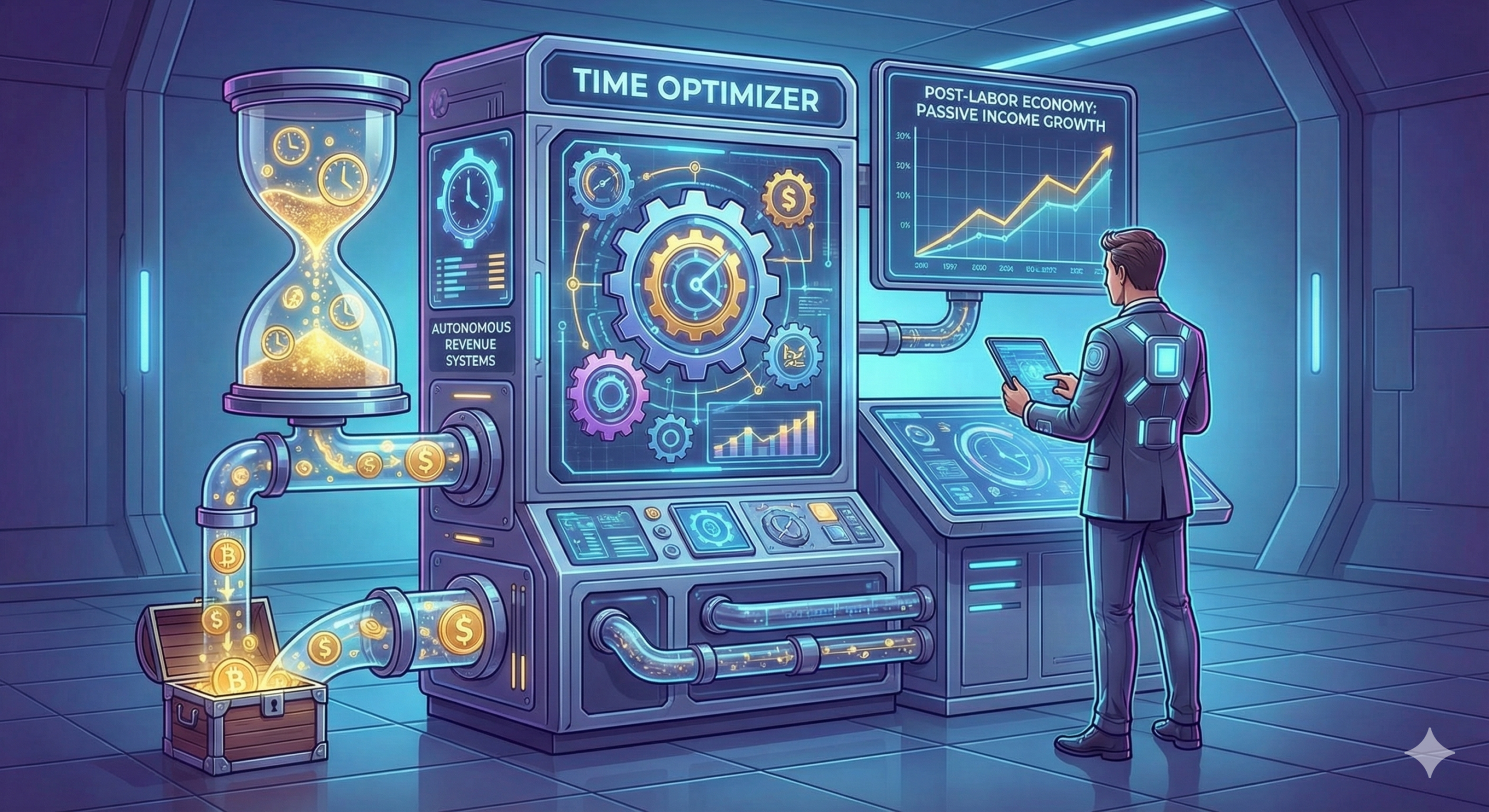
The most dangerous myth in the world of entrepreneurship is the glorification of the “grind.” We are culturally conditioned to believe that income is a direct function of effort—that to make more money, we must sweat more, work later, and sacrifice more sleep. While this linear equation holds true for the employee, it is a trap for the wealth builder. For the hyper-efficient individual, time is not an asset to be spent; it is a liability to be minimized.
True financial sovereignty is not achieved by finding spare hours to work a second job. It is achieved by building systems that render your active presence unnecessary. This is the shift from “Hustle Culture” to “Engineering Culture.” The goal is to construct an engine where your initial input of labor or capital creates an asset that continues to produce value indefinitely. We are looking for the “Sleep Dividend”—revenue that generates whether you are awake, asleep, or on vacation.
To achieve this, we must move beyond simple gig work and look toward Systemic Asset Creation. By leveraging the zero-marginal-cost economics of digital products, the algorithmic power of decentralized finance, and the leverage of labor arbitrage, we can build a portfolio that works harder than we do.
System 1: The Zero-Marginal-Cost Factory (Intellectual Property)
The fundamental flaw of selling a physical product or a service is the cost of replication. If you bake a cake, you must buy ingredients for the second cake. If you consult for an hour, you must spend another hour to earn again.
The Digital Product Ecosystem shatters this constraint. It allows you to build a “factory” where the cost of producing the first unit is high (your time and effort), but the cost of producing the millionth unit is zero. This is the realm of Intellectual Property (IP).
You likely possess a “Super-Spreadsheet”—a complex financial model, a project management dashboard, or a tax reconciliation checklist—that you built to survive your own job. To you, it is a tool. To the market, it is a product. By polishing this tool and listing it on a platform like Gumroad or Shopify, you transform your tacit knowledge into a tradeable asset. The magic lies in the automation. A customer in Tokyo finds your “Freelance Tax Calculator” at 3:00 AM your time. They purchase it. The platform processes the credit card, encrypts the file, delivers the download link, and sends a thank-you email. You wake up to a notification of a sale. You did nothing in that moment to earn that money; you earned it three months ago when you built the system. This is the closest we can get to pure economic alchemy: creating value out of thin air and code.
System 2: The Algorithmic Banker (Financial Arbitrage)
For those who have already accumulated capital, the most efficient employee you can hire is your own money. However, the traditional banking system has convinced us that “saving” is enough. It is not. Inflation eats savings. To generate a side hustle income from capital, you must move from saving to deploying.
This system utilizes Automated Financial Arbitrage. In the traditional markets, this looks like the “Dividend Aristocrat” strategy—building a portfolio of ETFs (like VOO or SCHD) that pays you a quarterly salary just for holding shares. But for the risk-tolerant, the Decentralized Finance (DeFi) sector offers a paradigm shift.
Through Yield Farming and Staking, you can deposit stablecoins (digital dollars) into liquidity pools or lending protocols (like Aave). You are essentially acting as the bank, providing the liquidity that the market needs to operate. In exchange, you earn interest rates that dwarf traditional banks, often paid out every single block (approximately every 12 seconds). By setting up automated recurring buys (Dollar Cost Averaging) and utilizing auto-compounding vaults, you create a financial machine that requires zero human intervention. You are not trading; you are yielding. Your net worth becomes a living organism that grows autonomously, fed by the mathematical laws of the protocol rather than your daily labor.
System 3: The Search Engine Landlord (Content Authority)
If IP is the factory and Capital is the fuel, then Content is Real Estate. When you write a high-quality article or record a deep-dive video, you are claiming a plot of digital land.
The Content Authority Network relies on the principle of “High Intent.” Unlike social media, where you must constantly post to stay relevant (the hamster wheel), Search Engine Optimization (SEO) is about permanence. If you write the definitive guide on “The Best CRM for Freelance Architects,” you are targeting a user who is holding their credit card and looking for a solution.
By embedding Affiliate Links into this content, you turn the article into a toll booth. Every time a reader clicks your link and buys the software, you earn a commission. You write the article once. It takes ten hours. But that article sits on the internet for five years, intercepting traffic and generating revenue every single day. This is distinct from “influencing.” You don’t need millions of followers; you need specific, high-intent traffic. You are building a library of assets—reviews, tutorials, comparisons—that act as a 24/7 sales team. Your “work” is done upfront; the “income” is the long-tail annuity that follows.
System 4: The Labor Arbitrageur (Service Brokering)
Finally, there is a way to sell services without actually doing the service. This is the model of the Automated Service Broker, often called “Drop-Servicing.”
In a traditional agency, you sell your time. In a Brokerage model, you sell a System of Quality. Let’s say you identify a high demand for “Podcast Audio Engineering.” You do not edit the audio yourself. Instead, you build a sleek storefront that sells a fixed-price “Podcast Polish Package.”
When a client buys the package, an automated workflow triggers. The project files are sent to a pre-vetted contractor you have hired (perhaps from a lower cost-of-living region) who does the work for a wholesale rate. The completed file comes back to you for a final “Quality Control” check, and then you deliver it to the client. You profit from the spread between the retail price and the contractor’s rate. Your value add is not the editing; it is the curation, the customer service, and the guarantee of quality. You have moved from being the laborer to being the architect. You are managing a workflow, not manipulating waveforms.
The Sleep Dividend
The transition from “Worker” to “Optimizer” requires a fundamental change in how you view value. The Worker asks, “How much can I get paid for an hour of this?” The Optimizer asks, “How can I build a system that does this for me?”
By implementing these four systems—IP creation, capital deployment, content real estate, and labor arbitrage—you stop renting out your life and start owning your future. You build a fortress of income that protects you, pays you, and, most importantly, frees you.